
Calling the recent Delhi blast a law-and-order failure alone would be an oversimplification. Branding it merely an intelligence lapse would be an institutional avoidance of fact. The truth is deep, structural, and systemic governance failure.
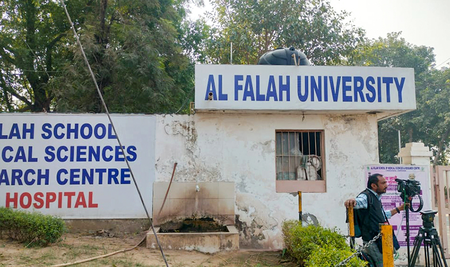
The investigations have led the security establishment on an unsettling trail that points not to a remote terror den or an underground hideout, but to the campus of a university just across the Delhi–Haryana border in Faridabad. As probe agencies dig deeper, Al Falah University has emerged as the alleged nerve centre where parts of the conspiracy were conceived.
While the dramatic revelations have reignited debates on policing, intelligence sharing, and radicalisation, the real story runs much deeper. What the ongoing investigation lays bare is the hollowed-out state of regulatory apparatus, particularly in the higher education sector.
Following the revelations, in a knee-jerk reaction, licenses are being cancelled, promoters arrested, and hundreds of students now face uncertain academic future. The fact that a fully recognised, ostensibly well-monitored university could become a breeding ground for extremist activity, despite layers upon layers of government oversight, is damning.
Higher and professional education institutions operate under a maze of regulations. The University Grants Commission (UGC) governs broad academic standards, the All India Council for Technical Education (AICTE) regulates technical education, and the National Medical Commission (NMC) oversees medical programmes. Accreditation bodies such as the National Assessment and Accreditation Council (NAAC) and National Board of Accreditation (NBA) evaluate quality benchmarks.
Alongside these central bodies, each state runs its own regulatory authority to ensure compliance on infrastructure, faculty, safety norms and academic delivery. For universities running professional courses, yet another layer enters the picture. National Testing Agency (NTA) officials responsible for examinations like JEE and NEET conduct periodic verifications and audits tied to testing infrastructure and academic standards. Income-tax departments, GST authorities and financial intelligence units monitor financial flows, expenditure patterns and tax compliance.
In theory, no educational institute can function for a week, let alone house organised criminal or extremist activity, without the government knowing. Every licence granted without scrutiny, every inspection passed with a bribe, every compliance report rubber-stamped without verification, chips away at the foundation of regulation infrastructure.
The blast revelations should also make us realise the failure was not one of absence of systems, but collapse of will, honesty, and institutional accountability within them. The state prides itself on its surveillance architecture. But this episode shows how surveillance is only as effective as the people handling it.
Intelligence alerts mean little if local authorities are compromised. A university management under scrutiny could still flourish, expand and attract students all while sitting atop a festering pool of irregularities and, allegedly, extremist infiltration.
This is not the first institutional failure of this nature. But it is among the most alarming, because it involves students, young lives whose education and careers are now collateral damage in a battle between regulatory negligence and extremist influence.
A campus with manipulated admissions, poor documentation, lax faculty oversight, and no monitoring of guest activities becomes fertile ground for radical elements to slip under the radar of agencies. The real danger is not that one university allegedly harboured such elements. It is that the ecosystem allowed it to happen.
What India needs is not more regulation, but cleaner regulation. Not more surveillance, but meaningful oversight. Not periodic audits, but continuous, technology-driven monitoring but more importantly insulated from corruption and political interference.
The Delhi blast should shake the conscience of the regulatory establishment. It should force a re-evaluation of how universities across the country are approved, monitored and audited. Most importantly, it should ignite a national conversation on the price we pay when governance becomes a facade.
