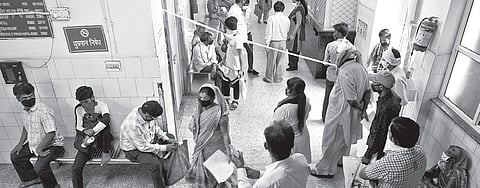

All-time high OPD cases, packed eye-care centres, and chemists are reporting unprecedented spikes in the sale of inhalers, cold syrups, and nasal sprays—Delhi’s air pollution grapples all. It is a full-blown ‘public health emergency’, as the AIIMS pulmonary head termed it three days ago. City doctors say the crisis is changing the baseline of health in the city.
People who never had a history of asthma issues are developing symptoms. Chronic patients are suffering a faster deterioration. Children’s lungs are under stress. Pregnant women and infants are at heightened risk, and healthy young adults are waking up with inflamed eyes, congested sinuses and persistent coughs and headaches.
The State of Global Air 2025 report warns that India recorded over two million deaths linked to toxic air in 2023. With PM 2.5 concentrations in South Asia among the highest worldwide, experts describe it as a deepening environmental and human crisis.
Environment experts and policy-makers are of the view that India’s pollution stems from multiple sources, with residential solid-fuel burning contributing around 30% of the ambient PM 2.5, with vehicles, coal-fired power plants, industrial emissions, and agricultural residue burning adding to the load.
“Delhi represents the sharp edge of India’s air pollution emergency,” said Dr Rakesh K Chawla, the head of the department of respiratory medicine, sleep and interventional pulmonology at Jaipur Golden Hospital in Rohini. He pointed out that each winter, particulate-matter levels soar to nearly 10 times that of the WHO safe limit.

“After Diwali and the stubble-burning season, the city sits under a lid of stagnant cold air that traps toxins. This isn’t just a seasonal inconvenience; it’s a continuous assault on lungs that weakens immunity, worsens asthma, and accelerates chronic lung disease. Clean air must be treated as a basic right, not a luxury dependent on weather or wind,” he said.
Meanwhile, Dr Dhruv Chauhan, national spokesperson of the Indian Medical Association, said, “Doctors in Delhi NCR are seeing increased cases of respiratory issues in emergency and OPDs, and all this madness and environmental destruction is happening without even a single major step taken to resolve it till now.” He also said, “It doesn’t matter if you are healthy or not; a human body is prone to these allergies. Earlier people used to call, ‘Love is in the air’; now people say, ‘TB and pollutants are in the air.’”
Expert Advice
Rising pollution levels are also triggering a sharp increase in eye-related complaints across Delhi hospitals. Doctors report a surge in severe allergies, irritation, and dryness as poor air quality continues to worsen symptoms.
Talking about the eye irritation problems rising in hospitals, Dr Ikeda Lal, director of the Delhi Eye Centre, said, “The number of patients complaining of itching, redness, dryness and irritation has gone up by approximately 40-50%. We are seeing patients with severe eye allergies, and those who already have dry eyes are experiencing much more discomfort than usual. The PM levels in the air are even causing inflammation in the eyes.”
She further said, “We are urging the patients to wear powered and protective glasses and use cold compresses when in need. Also, the office workers should be taking a break from the screen time after every 20 minutes and looking at the object which is 20 metres away. Also avoid usage of contact lenses. The medication for the eye allergies is only in the form of lubricants.”
Children bearing the brunt
According to a Centre for Research on Energy and Clean Air (CREA) study, 40% of the PM2.5 inhaled by children travels to the deepest part of lungs. The infants are also affected by this. Both children and infants have a deep-lung deposition rate of 30% for PM2.5, which is significantly higher than for PM10, making it a more hazardous pollutant for children and infants than PM10.
“Our research shows that fine particulate matter (PM2.5) poses a serious health risk to children because of how deeply it penetrates into their lungs. Approximately 40% of inhaled PM2.5 particles reach the deep lung regions (pulmonary) in children aged 8 to 9 years, with even infants exhibiting about 30% deposition in the pulmonary zone. If we are serious about protecting children’s health, reducing PM2.5 levels must be the top priority,” said Dr Manoj Kumar, analyst at the CREA.
Premature deliveries
In July 2025, new research added another alarming dimension to Delhi’s pollution crisis, linking toxic air to adverse birth outcomes across India. An analysis by researchers from IIT-Delhi, the International Institute for Population Sciences (Mumbai), and institutes in the UK and Ireland shows that exposure to fine particulate matter (PM2.5) during pregnancy significantly increases the risk of premature births and low birth weight—two key indicators of infant health.
Drawing on National Family Health Survey-5 data and satellite-based pollution estimates, the study found that higher PM2.5 exposure was associated with a 40% higher likelihood of low birth weight and a 70% higher chance of preterm delivery. Climate factors such as temperature and rainfall further intensified these risks.
The national demographic health survey (2019–21) recorded that 17% of children in Delhi were born prematurely, higher than many northeastern states. The capital also ranks among the regions with the highest prevalence of low birth weight, trailing only Punjab but ahead of Haryana, Madhya Pradesh, and Uttar Pradesh.
With winter pollution worsening each year and PM2.5 levels routinely breaching hazardous limits, experts warn that the city’s toxic air is not only choking its residents but also harming unborn children, deepening the long-term public health burden.
Authorities step up
It was on November 12 when the Centre had issued an updated advisory to all states and Union territories, directing them to strengthen preparedness in government health facilities to tackle the growing burden of air pollution-related diseases. The Union health ministry has instructed states to operationalise chest clinics under the National Programme on Climate Change and Human Health (NPCCHH), especially during the peak pollution months from September to March, when respiratory and cardiac cases typically surge.
According to the ministry’s 33-page guideline, these clinics, set up initially in urban community health centres, district hospitals and medical colleges across National Clean Air Programme (NCAP) cities, must function for at least two hours daily. They are expected to screen patients for risk factors, confirm diagnoses, and provide treatment and long-term care for pollution-aggravated respiratory and heart ailments. Health facilities have also been asked to maintain digital records of patients through platforms such as the Integrated Health Information Platform (IHIP) and share details of high-risk individuals with ASHA, ANM and CHO workers for community-level follow-up.
The advisory emphasises training healthcare staff to manage respiratory and cardiovascular emergencies, promoting behavioural change among patients, and ensuring adequate availability of medicines, oxygen cylinders, nebulisers, ventilators, beds and ambulances.
The health secretary, Punya Salila Srivastava, noted that deteriorating winter air quality poses a “significant health challenge” across several regions. Children under five, the elderly, pregnant women, asthma and heart patients, and outdoor workers remain most vulnerable. States have been asked to curb pollution from construction sites, waste burning and crop residue. Construction workers should be provided protective gear, dust suppression measures must be enforced, and regular health check-ups must be ensured.
Schools have been advised to restrict outdoor activities when AQI turns poor or worse, sensitise staff, and promote awareness among students through activities on air pollution. Long- and short-term exposure, the advisory warns, can trigger symptoms ranging from eye and throat irritation to asthma attacks, COPD exacerbation, heart disease and even premature death.
Financial burden
For families like that of Javed Hussain, a resident of East Delhi, the city’s toxic air has become an unbearable financial strain. The sole breadwinner of a seven-member household, Tabish has been spending far beyond his means this month as pollution-triggered illnesses tighten their grip. His two young children and bedridden elderly parents have been coughing continuously for three weeks, with no signs of relief.
“My father has been a heart patient since 2015, and every winter is worse than the last,” he says. “This season, the pollution has pushed us to the brink.” “You can’t give the same medicine to kids and elders. So every week, we end up buying two sets,” he explains. On top of this are the nebuliser solutions, where a pack of five respules costing `115 gets used up within two and a half days due to severe congestion. In total, the monthly spend on basic respiratory care runs into a substantial, unavoidable sum. “Not everyone can afford air purifiers. We are just helpless,” Javed said quietly.
Surge in medication demands
According to the data shared by the druggist associations for the month of October 2025, Delhi has witnessed a sharp rise in demand across all major respiratory drug categories – anti-asthma and COPD medicines, cough and cold formulations, and several nasal preparations.
Among anti-asthma and COPD drugs, many leading inhalers such as Foracort, Budecort, Duolin, Asthalin, and Montair LC recorded double-digit month-on-month growth, indicating a spike in breathing-related distress. This rise is mirrored in the cough and cold segment, where dozens of brands, especially those containing chlorpheniramine, ambroxol, and decongestants, showed unusual growth.
Even the nasal spray category, which typically moves slowly, saw sharp increases for fluticasone-, oxymetazoline-, and saline-based sprays, underscoring widespread complaints of congestion and airway inflammation. The simultaneous surge across inhalers, nebulisation solutions, cough syrups, antiallergics, and nasal sprays suggests a significant escalation in respiratory illnesses, likely driven by severe air pollution.