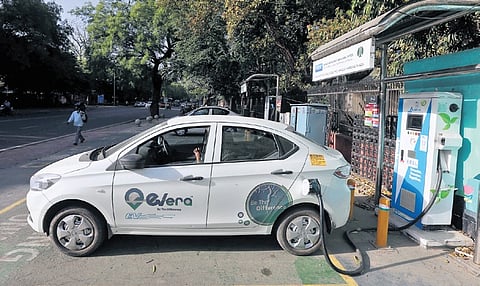

NEW DELHI: Amid reports of Delhi’s transport department finalising a fresh draft for the city’s electric vehicle policy, industry experts are assessing whether the existing infrastructure is adequate to support the government’s ambitious transition from internal combustion engine (ICE) vehicles to EVs.
The draft policy, expected to be made public after ministerial approval, recommends strengthening the city’s EV charging ecosystem, expanding battery-swapping stations, developing battery recycling facilities and widening the e-rickshaw network.
The proposals aim to accelerate Delhi’s shift toward clean mobility and reinforce its position as a leader in EV adoption. However, experts caution that the feasibility of these recommendations hinges on addressing several infrastructural and supply-related challenges.
Anurag Singh, advisor at Primus Partners and an industry expert noted that deploying EV infrastructure at the scale envisioned poses multiple hurdles. “In the case of Delhi, as well as most Indian cities, there are challenging points such as the availability of electricity, grid capacity, charging points, and especially given current restrictions related to China—the availability of raw materials needed to manufacture EVs and batteries,” he said.
Experts emphasise that while India is progressing in clean energy and advanced automotive technologies, the country is still some distance away from achieving the level of readiness required for a fully mature EV ecosystem. Supply chain constraints, particularly for battery components, remain a key concern. Delhi’s previous EV policy, introduced in 2020, expired in August 2023 but has undergone multiple extensions as the government works on the revised framework.
It is currently effective until March 2026. Under the 2020 policy, the city saw a rapid increase in EV adoption and charging infrastructure, but officials and industry watchers agree that significant expansion is still required. As of August 2025, government data shows that Delhi has 1,967 EV charging stations, with plans for further expansion as part of the new policy.
A Delhi-based EV industry expert said the national capital has been “aggressively pushing for electrification,” and its targets are achievable. On battery recycling, he noted that while the need is currently limited due to the early stage of market penetration, startups have already entered the space. With time, he added, recycling will become an integral component of the EV ecosystem.
Anti-smog gun installed on 149 buildings
Hospitals, malls and court complexes are among the commercial establishments that have already fitted anti-smog guns as civic agencies race to meet a November 29 compliance deadline, officials said on Tuesday. Municipal records show that 149 buildings across Delhi have completed installation of the pollution-control devices so far.
The list includes offices, hotels, mixed-use properties, shopping malls, hospitals and both government and private establishments. Work is ongoing across several commercial zones within the MCD area.
