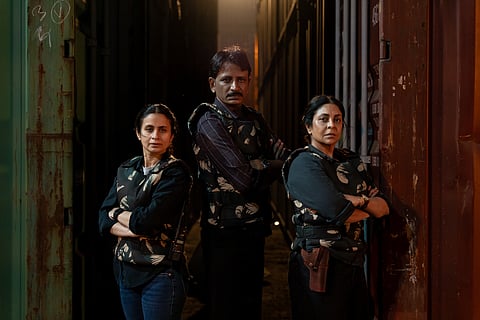

Inspector Bhupendra Singh is the quiet centre of DCP Vartika Chaturvedi's team in the Netflix cop drama Delhi Crime that has just dropped its third season. As seen in the first two seasons, Singh, played by veteran actor Rajesh Tailang, understands power and hierarchy. He has immense experience but does not overplay his hand. And he even advises DCP “Madam, Sir”, played by Shefali Shah, on how to get out of a jam with her boss. Misogyny is not part of his office culture.
Tailang as Singh is the ‘new male cop’ in increasingly women-led plots in films and OTT series. The one who has to come to terms with not calling the shots, and being the support system. But as an actor who has much to give, it is tough to be routinely considered the dependable second lead.
Tailang is ready for lead roles and has shown what he can do on screen -- from Mukkaebaaz to Selection Day to Mirzapur and Delhi Crime -- usually playing hard-boiled characters, or men who burn from fires they lit. An artiste of many parts, he has directed and written television episodes. In between working for films and the OTT series, he does theatre and teaches at his alma mater, the National School of Drama. As he said in an interview with his trademark confidence: “I’m waiting…but not free.” Excerpts from a conversation:

Bhupendra Singh is a good advertisement for Delhi cops. It is a measured and controlled performance. Singh is the head of a special Action Force but you did not play it in a macho way.
Like every cop is not James Bond, real cops and spies don’t act like Simbas or Inspector Vijay [of Zanjeer]. If they did, they would be very bad at their job as they would draw attention to themselves.
Are crime shows the new voyeurism? There is thrill, a dark side, but also justice and resolution. They make us feel ultimately safe, that we are in good hands.
According to me, crime thrillers and police procedural dramas are always ‘hits’. CID has been running for the past 18 to 20 years.
Would you say Bhupendra Singh is an understated character?
In the screenplay, he is understated, but whichever character I play, I play it like a hero. There is a lot of understanding in the team, and we are all professionals, so we know in which scene who needs to be given importance.
Also, we are now seeing more and more women-centric and women-led stories being written. The criminals are women and those giving them the chase as well. Women characters are being written giving them more agency, so, naturally, that will change the way male characters are being written; a male cop in a female cop-led drama will have less agency.
Who did you model the inspector on? You play it as if you didn’t want yourself to be noticed.
Doing nothing in a scene is more challenging for an actor. Even when the camera is on, I don't think about what the camera is capturing. I just try to be there authentically.
The person my character is largely modelled on is Rajendra Singh (an inspector with the Nirbhaya case, later an Assistant Commissioner of Police). I tried to catch some of his gestures. He is a very calm person, but very aware and observant, just like a tiger before he springs to catch his prey. Then there’s a US reality show called Caught in Providence, a live telecast of courtroom proceedings. It had an Inspector Quinn, and the way he would talk to the judge – though respectful, Quinn stood his ground always. He, too, was an influence.
Would you want to play a cop who takes over the screen like the way Sanjay Dutt did as A A Khan, head of the ATS in Shootout at Lokhandwala or Amitabh Bachchan’s Vijay in Zanjeer?
Actually, why not. Who wouldn’t like to play a protagonist? In fact, I’m a little irritated when people say you were a great support…. I want to play the main role, be at the centre.
Did Delhi influence you in any way? I believe you have had a long association with the Delhi Police.
I have a house in Delhi, and yes I was at NSD where I picked up, or am still picking up my skills. I also directed many episodes of India’s Most Wanted, so I was in touch with cops. I still have at least 300 FIRs of different criminals as research for the series. About 10-12 years ago, I also wrote 100 episodes of Crime Patrol. I know how the thana functions. It’s always been my aim to show the man behind the uniform. Rajendra Singh, however, said: 'I'm more menacing than the way you played it."
Other than director and script, what do you look for when you say yes to a role?
I need to find the world in it interesting. I also see how integral is my contribution to that world. If it’s a film or a series and you were to describe it in one para, I see if my character’s name finds a mention there. Then I also do look at the director and producers and the team, and if it can be a fertile ground where I can flourish.