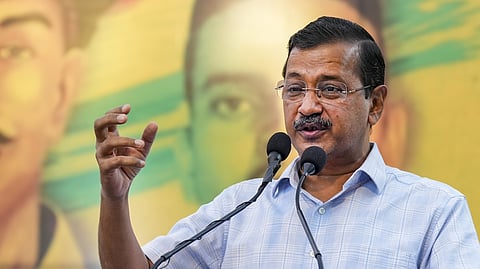

In the winter of 2013, Arvind Kejriwal had swept to power in the national capital, with his party getting unexpected success in the assembly elections.
Kejriwal’s campaign focused on the luxury enjoyed by those in public office and swore not to use luxurious government accommodation or transport as long as he remained in office.
In a case of rare theatrics, the Aam Aadmi Party (AAP) leader had operated from the government apartment allotted to his wife at Kaushambi in Delhi’s suburb of Ghaziabad. He had also done the drama of taking a Metro ride from Kaushambi to his office.
Fast forward to 2025, out of office for almost a year now, Arvind Kejriwal is fighting a bitter battle in Delhi High Court for a Type VIII accommodation in his capacity as former Chief Minister of the national capital territory. His lawyer had mentioned before the court, “It has to be a Type VII or VIII. They cannot downgrade me to a Type V. I’m not favoured. I’m not Bahujan Samaj Party(BSP).”
Now what does a Type VIII bungalow come with? These are the largest class of government bungalows in the Lutyens’ Bungalow Zone. Allotted to very senior functionary and officials like Cabinet Ministers, Supreme Court or High Court judges, and top secretary-level bureaucrats among others.
The main house is about 9,175 square feet for a Type VIII bungalow. In addition to the main house, there are at least six staff quarters, garage(s), office space, guard rooms, sentry posts, and frisking rooms for the staff. Besides staff quarters, there is separate space (often referred as servant quarters) for support staff for housekeeping, drivers and gardeners.
These Type VIII bungalows come with large private lawns and gardens and driveways. Inside the house are colonial high ceiling rooms, drawing rooms, large dining halls, multiple living rooms and bedrooms and more often than not a study or library.
So this is the kind of house for which Arvind Kejriwal is fighting pitched battle in the court room. And in what capacity? As former Chief Minister of Delhi. One doubts that ever a bungalow has been allotted to a former Chief Minister under that category.
Kejriwal’s predecessor Sheila Dikshit, soon after demitting office, had shifted to a friend’s apartment on Firozshah Road and thereafter shifted to her own apartment in Nizamuddin East. Her predecessors Sushma Swaraj, Sahib Singh Verma and Madanlal Khurana did stay in official bungalows but in their capacity as Union Ministers or Members of Parliament.
One can recall that Jag Pravesh Chandra, who was the last Chief Executive Councilor before the Metropolitan Council was disbanded, lived in a small apartment in Khan Market. And here we have Kejriwal demanding a bungalow as pensionary benefit.
Incidentally, in its order in a public interest litigation, the Uttarakhand High Court some years back had held that free government accommodation, cars and other facilities to former chief ministers were not legally sustainable and asked the state to compute market-rate rent for the period of occupation and recover it from ex-chief ministers. The High Court observed such amenities provided free of cost were unconstitutional and illegal.
The government had tried to undo this order by bringing an Ordinance which too was subsequently struck down by the High Court.
The apex court in an order passed earlier in 2016–2018 had struck down state laws/rules that purported to give permanent entitlement to ex-CMs and directed recovery of market rent where appropriate. However, the executive has passed fresh rules, notifications to pass on such privilege.
Kejriwal’s demand for a lavish bungalow contradicts the ethos of simplicity and austerity that had propelled him to office. It would erode his credibility further as a politician who once vowed to dismantle privilege. It had suffered big dent when the Sheesh Mahal controversy had broken out, wherein he as Chief Minister had got his colonial official bungalow refurbished into a lavish and luxurious personal pod.
Thus, both constitutional principle and moral consistency weigh against Kejriwal’s demand. Providing him a Type VIII bungalow as a pensionary privilege would not only violate judicial precedent but also undermine democratic accountability by reinstating precisely the VIP culture the Aam Aadmi Party (AAP) once opposed.
Sidharth Mishra
Author and president, Centre for Reforms, Development & Justice
