
For most Delhiites, mornings mean a stroll through the leafy expanses of Lodhi Garden or the heritage-rich lawns of Sunder Nursery. Yet, tucked away quietly on the west bank of the Yamuna — just opposite the bustling Sarai Kale Khan bus stand — lies a hidden gem. Baansera Park, with its sprawling bamboo groves, tranquil water bodies, and breathtaking views of Humayun’s Tomb, is the capital’s newest ode to green living and river rejuvenation.
Spread across 402 acres, Baansera Park stands as a shining example of how the neglected floodplains of the Yamuna can be transformed into ecologically rich and aesthetically inviting spaces. Developed by the Delhi Development Authority (DDA) as part of the larger Yamuna Riverfront Development Project, the park embodies a rare balance between recreation and restoration.
Where bamboo meets the moon
Baansera, literally translating to bamboo haven lives upto its name, meandering through its greeny trails with amber-coloured sand beneath the feet feels almost meditative. The paths, lined with dense clumps of green bamboo and rustic benches, lead you to what locals fondly call the moon — a raised plateau that serves as a natural viewing point. The view there opens up to the dome of Humayun’s Tomb on one side, framed against the soft curve of Yamuna and the silhouette of the Barapulla flyover on the other side.

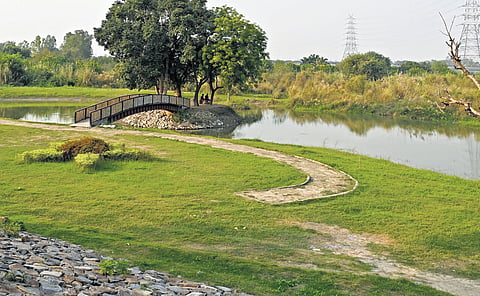
The design of this park thoughtfully merges modern landscaping with nature’s raw textures. Three interconnected water bodies punctuate the park, one hosting a set of musical and colourful fountains that come alive during the evening, while ducks glide and birds hum lazily at the other two. It’s biodiversity is beginning to flourish, attracting migratory birds and creating a thriving ecosystem. Just as when you take left from this moon through the bamboo trail a narrow stone path curves gently across the stretch taking you to a small wooden bridge that arches over a still pond.
On the other side, beneath the shade of thick trees, a couple sits on a lone bench, their laughter mingling with the soft rustle of leaves. Every now and then, they toss small pebbles into the water, watching the ripples spread and fade away, as if time has slowed down in this hidden corner of the park. The scene carries a quiet, village-like simplicity, where nature’s calm reigns and life seems stripped of all urban noise. For a couple of seconds, you may forget that you are in Delhi, especially in the Sarai Kale Khan area, which is usually considered to be the most polluted.
This tranquil landscape is soon expected to echo with verses, as the Urdu literary festival Rekhta is set to be held there in December, bringing poetry, people and culture together by the Yamuna’s edge.
A cafe in the greens
At the heart of Baansera is a small cafe perched on a gentle. With its bamboo and cane architecture, it feels like a hill station retreat — a rare escape similar to something you’d stumble upon in the hills of Uttarakhand. Around it, the park opens into a vibrant play zone, complete with bamboo bridges, slides, adventure trails, and even a tiny rabbit tunnel. “It feels like nature made this park. It looks like a space designed not just for recreation but also to introduce kids to the joy of playing close to nature, ” said a young mother, watching her son climb a bamboo frame.
Sustainable urban renewal model
Baansera Park isn’t an isolated experiment. It’s part of a growing network of green lungs reshaping Delhi’s relationship with the Yamuna. Over the past few years, initiatives such as the Yamuna Biodiversity Park in Wazirabad, Golden Jubilee Park near Old Delhi, and Sonia Vihar Wetland Park have shown how floodplains can be revived through careful ecological planning.
Each of these projects emphasises minimal concrete intervention, relying instead on native plant species, wetland restoration, and natural stormwater management systems. Baansera takes this approach a step further by weaving in recreational amenities without disturbing the ecological balance. The use of bamboo, a renewable material, across its structures underscores the park’s sustainability ethos.
Reviving the Yamuna narrative
For decades, the Yamuna was synonymous with pollution and neglect — a river reduced to a drain, fenced off from the city it once nourished. Projects like Baansera are attempting to rewrite that narrative. By reclaiming the floodplains for public use but in an environmentally sensitive way. Delhi is beginning to restore its bond with the river.
Whether it’s a quiet morning walk, a family picnic, or an evening spent listening to the musical fountains, Baansera offers a refreshing glimpse of what Delhi’s riverfront could be—a space where ecology, community, and leisure coexist. It stands not just as a park but as a vision for the city’s future: sustainable, inclusive, and rooted in harmony with nature.
History of the riverfront project
Spreading over an area of 15 hectares, Baansera falls within the 100 hectares of the Kalindi Aviral project. Lieutenant Governor VK Saxena first visited the site in June 2022 and shared his vision for a bamboo-themed public space for the people of Delhi. “The name has been derived from the Hindi word ‘Basera’, meaning ‘abode’, thus Baansera stands for the bamboo abode,” he said.
“Baansera is one-of-a-kind experience in terms of spaces designed amidst a plantation of almost 30,000 bamboo of about 15 varieties of the Bambusa and Dendrocalamus families planted in the form of groves and in setums. Apart from plantations, the park will have amenities designed in bamboo, an eco-friendly material,” he added. The project was
inaugurated by the L-G on August 9, 2022. An arrival zone has been proposed, acting as a transitional area from busy life into the pristine floodplains of the river. It would allow one to take a walk along a bamboo plantation and water body that has been restored from an existing depression earlier used for dumping while providing spaces to gather and leisure for the public. An interpretation centre also made in bamboo has been proposed in this arrival zone to showcase the restoration works being carried out by DDA for the floodplains of River Yamuna. This area is accessed from along DDA’s existing Smriti Van.
A vast area approximately measuring 2-2.5 hectares at a height of 6-7 mts. From ground level, which was previously used for infrastructure activities to dump C&D waste, it has been restored by removing tonnes of waste to designated sites. This portion of the site has been developed into a large grassed congregational space with a wide performance area and provision of a convention centre in bamboo. It is lined with pathways on the periphery, which take one amidst the bamboo groves.
An intermediate terrace with planting beds for seasonal plantation arranged in a radial pattern has been created as a treat to the eyes. A seating shelter has been provided such that it seems to be emerging from the seasonal flower beds. This terrace is connected to the congregational area above through a path of stepping stones.
Another intermediate terrace on the other side of the top congregational area has been proposed with a cafe made of bamboo along with the provision of outdoor seating amidst bamboo groves. Floral and cafe terraces form attractions for the public on two different sides of the congregational area.
A large depression has been restored into a water body with fountains giving a soothing view from the congregational terrace. Kaccha pathways in murram have been developed that run along the entire periphery of the water body, with seating areas proposed at intervals for the public to enjoy the experience of a riverfront promenade in the park.
Large spaces for seating and other activities have been designed within enclosures of varieties of bamboo plants. Bambusetum, an area is being developed as a bambusetum which has been planted with the 15 different varieties of bamboo.
The list of species is annexed. Apart from bamboo plantations, riverine grasses have been proposed along the edge of the river for about 100 m, followed by planting of native tree species of floodplain ecology that will be planted in a multi-tier format of ecological planting.
Use of solar lights that dim down around midnight is used in the floodplains. For further protection of the floodplains and to avoid future encroachments, private security has been deployed along with CCTV surveillance.
Not restoration but reclamation
“Inspired by PM Narendra Modi’s vision of restoring 2.6 crore hectares of the country’s degraded land by 2030, we took a baby step in Delhi on May 28, 2022, right after I took over as Delhi LG,” said LG Vinai Kumar Saxena. Once a heavily degraded and polluted stretch, Baansera has undergone not just restoration but complete reclamation and transformation within just 18 months, he said, which is a testament to the dedicated efforts of the Delhi Development Authority (DDA), the custodian of the Yamuna floodplains.
Today, this green haven boasts around 30,000 bamboo trees towering over 30 feet, alongside native species, lush lawns, vibrant flowers, and serene water bodies. Baansera has evolved into both a recreational hotspot and an ecological marvel in the capital.
What began as a small step toward enhancing Delhi’s floral diversity has blossomed into something extraordinary. The fertile grounds now nurture Meghalaya’s renowned Lakadong turmeric and blooming tulips. Once a foul-smelling landfill buried under construction debris and encroachments, Baansera has been reborn as an oasis — its bamboo plants releasing 30% more oxygen than most trees while rejuvenating the soil beneath.
The park now buzzes with life, hosting social and cultural gatherings such as kite festivals, yoga sessions, and musical evenings. According to the DDA website, citizens can even book the venue for personal celebrations like birthdays and weddings. Baansera stands as a shining example of the Yamuna floodplain’s remarkable recovery, a symbol of how nature, when nurtured through thoughtful and sustainable efforts, can heal itself and flourish once again.
Key riverfront projects
The Delhi Development Authority (DDA) has been working on multiple projects along the Yamuna floodplains to revive and transform them into green, accessible public spaces. Among the key initiatives, Asita East, spread across 197 hectares on the eastern bank between the Old Railway Bridge and ITO Barrage, has already been opened to the public and features ecological, interactive, and recreational zones.
On the opposite bank, Asita West, covering 200 hectares, is being developed in the same stretch. Nearby, Baansera, a bamboo-themed park also on the western bank, showcases bamboo plantations and eco-friendly amenities, with about 30% of the work completed.
Further south, the Kalindi Aviral project spans 100 hectares between the Nizamuddin Bridge and DND Flyway, while the Amrut Biodiversity Park, spread over 90 hectares between the new railway line and Nizamuddin Bridge, is nearing 90% completion and already hosts thousands of trees.
Another major project, Yamuna Vatika, covers 200 hectares and includes six restored water bodies, with around 65% of the work finished. Once complete, Mayur Nature Park, stretching over 372 hectares from Nizamuddin Bridge to DND Flyway, will be the largest of its kind along the Yamuna. In the northern section, Vasudev Ghat — a 16-hectare green zone with manicured lawns and a 3 km cycling track — extends from the Wazirabad Barrage to the Old Railway Bridge. Together, these projects mark a significant step in the ecological rejuvenation and public revival of the capital’s Yamuna floodplains.