
Art evolved alongside humanity, recording not only what we saw but how we felt. The earliest known artworks were found deep within ancient caves—etched depictions of the lives people lived: hunting, gathering, dancing, celebrating survival. Somewhere along the way that primal connection was lost—burdening each brushstroke with layers of social and psychological meaning.
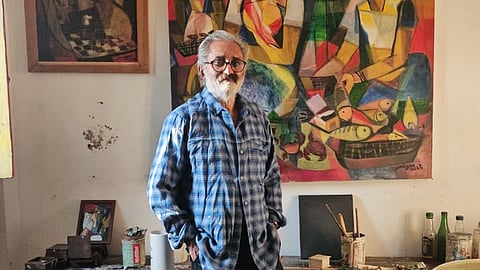
Art, at its core, is the artist’s world. Few embody this truth more fully than Sri Lankan artist Raja Segar, whose latest exhibition, ‘Rhythmic Sagas’, is currently on display at LTC, Bikaner House.
Organised by IndiGalleria, this much-anticipated exhibition marks Segar’s first solo show in Delhi, on till October 18. Curated by Aakshat Sinha, an engineer-turned-artist, the exhibition has drawn art connoisseurs, diplomats, students, and collectors from across India, earning acclaim for its vibrancy, depth, and the celebration of the human spirit.

Meet the artist
Segar is a prolific creator whose day begins with painting and ends the same way. His vivid works invite viewers to slow down, and simply ‘be’. ‘Rhythmic Sagas’ brings together themes of music, relationships, and everyday rhythm—moments that may seem ordinary but, through geometry and colour, become poetic. “They are what they are,” he insists. His world, his country through his eyes.
Segar’s journey to art was anything but conventional. Born into an economically vulnerable family in Colombo, life for him was about practicality—survival came before dreams. He is not a trained artist. In fact, his early fascination lay in science. “I never thought I’d become an artist,” he admits. After excelling in chemistry, he began working in a quality control department before shifting to accounting. His evenings, however, were spent at the British Council Library.
What began as an escape from monotonous office work soon became a calling. Segar started creating handmade greeting cards depicting scenes from Sri Lankan life—tea pluckers, street vendors, and plantation workers—imagery rooted in his surroundings rather than imported Western motifs. Tourists adored them. The demand grew such that
Segar had to recruit friends and family to help colour the cards. When buyers began asking for full-sized paintings, he taught himself to paint on canvas. “Someone paid me a big sum for my first painting,” he laughs. “That changed everything.”
Segar’s signature
Since then, Segar’s style has become instantly recognisable. His paintings blend Cubist geometry with the warmth of Sri Lankan realism, translating the rhythm of daily life into blocks of colour and light. “I was interested in geometry,” he says. “My early works had only straight lines. Later, I wanted to change—that’s how curves came in.” His relationship with form reflects his philosophy of growth: “One cannot keep doing the same thing forever.”
Segar’s themes—dance, music, motherhood, and faith—speak to universal human experiences. Though he insists he has no real connection with music (“I can’t sing,” he chuckles), his paintings of dancers and musicians exude a sense of movement and joy. His works also revisit Christian imagery, reimagining ‘The Last Supper’ and ‘The Crucifixion’ through his distinctive lens of light and line. “I read the Bible as a child,” he recalls. “But I was always drawn to science—to truth and observation. That curiosity shaped me.”
Colour, for Segar, is emotional language. He gravitates toward reds, browns, and yellows--hues that evoke both energy and intimacy. His paintings of ‘mother and child’—inspired by artists like Vincent Manansala—are tender, while his depictions of tea pluckers have become emblematic of Sri Lankan identity. Today, Segar lives entirely off his art.
Through ‘Rhythmic Sagas’, curated with sensitivity and vision by Sinha, Segar invites viewers not to decode, but to feel. His art does not ask for interpretation—it asks for attention. From an accidental painter to a master of rhythm and form, Segar reminds us that art, in its truest sense, is not about understanding—it’s about ways of seeing.