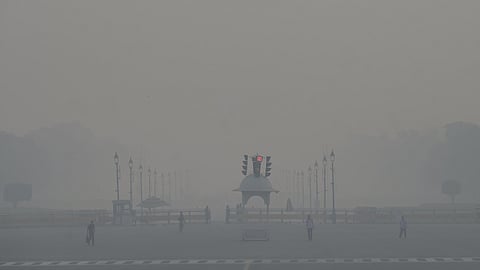

NEW DELHI: Just days after the Supreme Court permitted the use of green firecrackers in Delhi-NCR for limited hours during Diwali, the national capital experienced its worst post-festival morning in the past five years with the PM2.5 levels reaching 488 micrograms.
By 6:05 am on Tuesday, the city’s overall Air Quality Index (AQI) was recorded at 347, falling in the “very poor” category, according to SAFAR. Of the 37 air quality monitoring stations, 34 recorded readings in the red zone—indicating “very poor” to “severe” air quality. Last year, the AQI stood at 359 the morning after Diwali.
With the PM levels too surging this year, the city witnessed its worst air quality since 2021, with PM2.5 levels increasing to 488 micrograms per cubic metrewithin 24 hours after Diwali—over three times the pre-festival level of 156.6.
An analysis of CPCB data from 2021 to 2025 reveals a consistent spike in PM2.5 levels during Diwali night and the following morning. The 2025 reading of 488 is the highest in five years. Previous data shows PM2.5 levels rose from 163.1 to 454.5 in 2021, from 129.3 to 168 in 2022, from 92.9 to 319.7 in 2023, and from 204 to 220 in 2024.
Among the city’s 10 most polluted areas, Bawana topped the list with an AQI of 418, followed closely by Wazirpur at 408, and Jahangirpuri at 404, all falling in the severe category. Slightly better, but still alarming were Burari Crossing and Shadipur, both recording 393, and Ashok Vihar at 386, placing them in the very poor range. Other major localities such as Punjabi Bagh (375), RK Puram (369), Rohini (367), and Vivek Vihar (367) also saw the air thick with pollutants. The city’s average AQI was 388, firmly in the very poor bracket, with eight of the ten most polluted sites crossing 370.
Following the sharp deterioration, the Commission for Air Quality Management (CAQM) enforced Stage II of the GRAP across Delhi-NCR on October 19. If conditions worsen, authorities may escalate to Stage III.
Citizens, however, mocked the green Diwali initiative. “Delhi NCR is a pollution-free paradise where you can breathe oxygen straight from firecrackers,” posted Ruchika Sethi, a member of Citizens For Clean Air Bharat, in a sarcastic post.
Meanwhile, an old tweet by Delhi’s current CM from 2017 resurfaced -“My city is melting, it’s all smoke, in the air… So much poison, who is spewing it?” The post went viral again on Tuesday, capturing the city’s toxic irony.
Post-Diwali data
A trend (Last five years)
Oct 21, 2025: Delhi’s AQI touched 350 at 8 am, a day after Diwali, placing the city in the very poor category.
Nov 1, 2024: The morning after Diwali, the AQI rose to 359 at 6:30 am, according to SAFAR data.
Nov 13, 2023: At 8 am, Delhi’s AQI hit 438, slipping into the severe category. Just a day earlier, on Diwali morning, it was 269 (poor).
Oct 25, 2022: The capital recorded an AQI of 315, categorised as very poor, on the morning after Diwali.
Nov 5, 2021: Delhi gasped under an AQI of 454, firmly in the severe range, the day after Diwali celebrations.
Kids more prone to lung diseases
Health experts raised alarms over the worsening situation. Dr Dhiren Gupta, Senior Paediatrician at Sir Ganga Ram Hospital, warned that “Children are the worst hit, inhaling more toxins and becoming highly vulnerable to respiratory illnesses.”
NCR equally bad, records aqi of 412
The air was no less hazardous in NCR. Noida, Ghaziabad, and Faridabad each recorded an AQI of 412, falling in the severe category.
