
Last Monday we woke up awaiting Diwali celebrations. This Monday we are waiting for the Chhath festivities. The aftermath of Diwali saw political rivalries in full play.
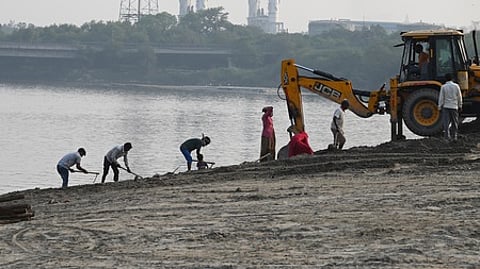
The ‘politicisation’ of Chhath puja has already begun. Chief Minister Rekha Gupta addressed a press conference last week outlining her government initiatives for making the puja possible in a ‘froth free’ Yamuna. Her Ministers and party leaders are flooding the social media space with reels and images of their input in making the Chhath festival clean and green.
The opposition is up with its snide remarks claiming that Chhath was expected to be as green and clean Diwali was, celebrated a week earlier. The quality of post Diwali air in the city, according to newspaper reports, rose to a five years high.
It was around the turn of the century that Chhath celebrations came to be ‘noticed’ in the city. In 1998, Mahabal Mishra was the first Bihari to be elected to Delhi Legislative Assembly. As part of his politics he started to wear his Bihari identity on his sleeves. Congress, the party Mishra belonged to, was in power then and Chief Minister Sheila Dikshit too was eyeing the bourgeoning Bihari population in the city.
BJP, then comfortable to remain a party with its base largely in the Vaishya and Punjabi communities, was late in taking note of the Biharis. Though in 1993, cricketer Kirti Azad had won on BJP ticket, and despite being son of a former Bihar chief minister Bhagwat Jha Azad, he saw himself as a Delhi boy having been educated at Modern School and St Stephens College.
Sheila Dikshit incidentally defeated the cricketer in 1998 polls. In 2003, BJP pitched his wife Poonam Azad against Dikshit. To create right political aesthetics, Poonam Azad did Chhath puja at then Deputy Prime Minister Lal Krishna Advani’s house under the patronage of party’s chief ministerial face Madanlal Khurana.
This year, despite the state elections being almost four-and-half years away, Delhi government is going overboard in the preparations for the puja. The main opposition Aam Aadmi
Party (AAP) has accused the BJP of hypocrisy, alleging that its claims of facilitating Chhath Puja was politically motivated rather than genuine.
They have accused the BJP of turning Chhath Puja celebrations in Delhi into an election strategy ahead of the Bihar Assembly polls. This could be stretching it too far as those celebrating Chhath here in Delhi are unlikely to travel to Bihar for voting in the assembly polls there. Not that the BJP is not eyeing the Bihar polls but it has addressed its migrant voters with Railway Minister Ashwini Vaishnaw working overtime to provide adequate number of trains to meet the festive traffic.
Coming back to the festivities in the city, it began almost 75 years ago, soon after independence, when government colonies came up around Lutyens’ Delhi. Since Dr Rajendra Prasad, a Bihari, was then the country’s President, the puja had some kind of his patronage, more so of his wife Rajvanshi Devi.
In those early days, Chhath was celebrated in the local ponds, which then existed in large numbers in the villages around these colonies. There are also some references about artificial ponds being built to celebrate the festival. However, the city as such remained largely unaware about this ancient Bihar festival.
The beginning of the bloody caste wars in Bihar towards the end of 1980s, accompanied by the closure of sugar and jute mills in the state and the neighbouring West Bengal saw the Bihar labourers making a westward move. By mid 1990s, this migration had gained momentum and the city landscape had started to change, both materially and culturally, as Biharis of every social and economic hue arrived in the city.
Though there are claims that the festival started getting celebrated on the banks of Yamuna sometime in the 1980s, they became ‘visible’ only around the turn of the century. One remembers the editor of the newspaper I worked for then remarking at the news meeting that Chhath was still to the official festival of the state.
Quarter of a century later, unfortunately, he is not alive to see that the festival has acquired that kind of a profile. However, it must be mentioned here that in the good old days in Bihar, the devotees did not look for government patronage for organizing the puja, it was more of a community initiative. Today it’s playing out not just in the politics of Bihar, which is going to polls, but also in a city thousand kilometres away inhabited by Biharis.
Sidharth Mishra
Author and president, Centre for Reforms, Development & Justice
