
The morning after Diwali in Delhi rarely smells like celebration. The faint perfume of marigolds and sweets lingers in the air, quickly overpowered by a dense haze that blankets around the city like a stubborn guest refusing to leave. For many families, this year’s festivities ended not with sparklers, but with sore throats and itchy eyes.
Yet amidst the smog that has enveloped the city, a quiet resolve is taking shape in , a promise that next year’s Diwali will shine not through firecrackers, but through lights, food, and flowers.
We want joy, not smoke
In Noida sector 94, the Bhatia family’s Diwali tradition of bursting crackers on the terrace came to an abrupt halt this year. “My daughter’s cough wouldn’t stop last night,” says Neelam Bhatia. “We realised the irony, we were celebrating the victory of light over darkness while choking on our own air.”
The family replaced fireworks with diyas, fairy lights, and a neighbourhood potluck.
“We didn’t miss the noise,” says Rakesh Bhatia. “The kids burst a few sparklers and came back for sweets. It finally felt like Diwali, not a contest.”
It’s a sentiment echoed across the NCR this year. Though crackers were burst with gusto across the city after the ban was lifted, some sections of the population chose to celebrate Diwali with eco-friendly decorations, flower-petal rangolis, and family gatherings that replaced firecracker marathons.
While The Supreme Court had restricted fireworks to certified green crackers, the implementation of this directive was found wanting on the ground.
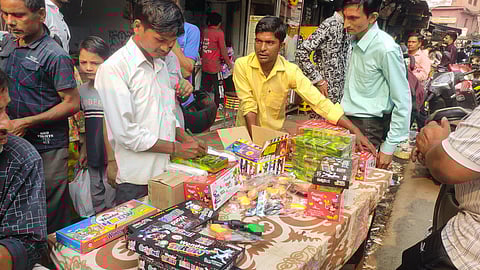
Across Old Delhi’s Jama Masjid lanes, sellers displayed green crackers and banned varieties side by side two days before Diwali. Many vendors said they did not have licences, and several boxes lacked the mandatory QR codes that identify certified green crackers.
Crackers were sold under labels such as “bada wala” and “chota wala.” Vendors said the former were green crackers while the latter were regular ones being sold without authorisation.
“People ask for whatever is loud. Green or not, everything is available,” said a shopkeeper operating from a tarpaulin stall.
According to Sunil Dahiya, director at Environcatalyst, the impact of weak enforcement showed up almost immediately. “This year, PM 2.5 levels touched 675 µg/m³, the highest since 2016. Green crackers are supposed to reduce emissions by about 30 percent, but the sheer volume of fireworks used this year wiped out the benefit.”
In the days leading up to Diwali, PM 2.5 levels stayed between 90 and 100 µg/m³, which is already above the Indian standard of less than 60 µg/m³. On Diwali night, several monitoring stations reported spikes up to 1,100 µg/m³, and some sensors failed.
Dahiya adds that crackers are only one part of the problem. “Stubble burning contributes, but it is not the only reason. Industrial and transport emissions release harmful gases throughout the year.”

Festival reimagined
At Rajouri Garden, families were out early the next morning, walking and chatting. One resident joked that they were “trying to inhale something other than nitrogen dioxide.” Among them were the Raos, who had skipped crackers entirely this year. Their 12-year-old daughter, Nidhi, came home from school with a “no-crackers pledge” and insisted that the whole family sign it.
“She was very firm about it,” says Aruna Rao. “So we decided to try a quieter Diwali.”
The family spent the evening cooking together, exchanging gifts and setting up a small flower mandap outside their house. There were no fireworks or smoke, only lights, sweets and music. “It felt different, but in a good way,” Aruna says. “We realised this is what the festival used to be before the cracker craze.”
Experts say if households sustain this behavioral shift, Delhi could witness a cultural and environmental turnaround. Some RWAs are already planning ahead. “We’re proposing a community ‘lights-only Diwali’ next year,” says Rajeev Batra, president of a residential welfare association in Rajouri Garden. “Each block will set up a shared lighting display, food stalls, and folk music, no crackers, no smoke. Crackers will be very minimal".
Is the air quality inching back to normalcy? While the jury is still out on that, back in Noida, Neelam Bhatia looks out over her balcony where diyas in neighbouring balconies still glow faintly. “Next year,” she says, “we’ll make it brighter with lights and laughter. The children deserve to see stars in the sky, not smoke.” It’s a small promise, but perhaps that’s how Delhi will change; not through bans and warnings alone, but through families choosing light over fire, and a government regulating emissions year-round.