
“If there are no buffaloes, there is no Toda” goes a saying among the Toda tribe, one of the indigenous communities of the Nilgiris in Tamil Nadu. Alongside the Todas, the mountains are also home to the Kurumba, Kota, and Irula tribes.
The Nilgiris, part of the Western Ghats, are known for their rich biodiversity. In the 18th century, the region’s cool climate attracted British colonisers, who later went on to clear tracts of land for tea plantations. After independence, much of the grassland was treated as wasteland and converted into eucalyptus and acacia forests, with seeds even scattered from aircraft. As a result, indigenous communities lost their homes, while their traditional grazing grounds slowly disappeared. But their art remains.
German artist Karolina Grzywnowicz focuses on Toda embroidery — a sacred ritual and traditional practice of the tribe — in her artwork. She stitches motifs of sun rays, mountain peaks, shola forests, lemon-scented thyme, the grassland’s six o’clock flower, and the moon onto an off-white background. For centuries, these patterns have contained coded messages, passed down through generations.
Grzywnowicz took part in a residency held in March 2024 at the French Institute of Pondicherry. The Berliner was one of five artists selected for their ecological interests, alongside Wendy Thermea, Danushka Marasinghe, Waylon D’Souza, and Rashmimala. Their works are currently on view at 'Travelling Plants', a transdisciplinary exhibition at the Foundation for Indian Contemporary Art in Delhi. Curated by Lina Vincent, the show explores how plants migrate and adapt to their surroundings, and examines the impact of history on ecology and nature.
A potted history
Baroda-based visual artist Rashmimala has been engaged with plant life for the last couple of years. “My first solo exhibition was also about the plant body, botanical illustrations, and natural history. So when I was invited for this residency, I instantly felt it was the right direction for me,” she tells TMS.
“The French Institute of Pondicherry has around 50,000 herbarium sheets preserved in its archives,” the artist adds. “That immediately caught my attention. I decided to keep aside my solo project and focus on this residency. It turned out to be a very good decision.”
A herbarium, she explains, is a scientific record of plants — their samples collected, dried, and preserved on sheets of paper, with details about when, where, and why they were collected. Such records go back centuries, from colonial botanists who carried plant samples back to Europe, to modern-day researchers studying ecological changes. “It is basically a library of plants.”
As told by Rashmimala, the institution also has a vast collection of plant pollen samples. “Before this, I had never seen pollen through an institutional microscope. Each species of plant has a unique pollen shape — like faces for us humans. Scientists can identify them instantly,” she notes.
The painter was particularly amazed to discover the ample records of history a tiny pollen grain could contain. “Pollen can carry information for more than 20,000 years,” she remarks. “It not only tells you about the plant it belongs to, but also about the environment, the climate, and the changes it went through. It’s almost like DNA.”
About Amaranthus
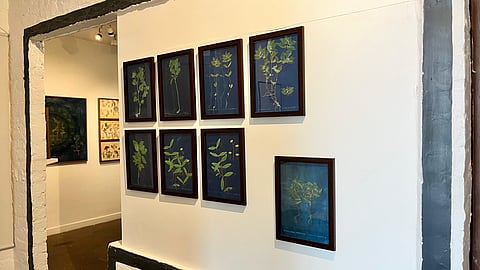
Amaranthus, a group of more than 50 species which make up the genus of annual or short-lived perennial plants collectively known as amaranths, is the subject of Rashmimala’s works. Some paintings are based on plant prints she collected during the residency. A geographic coordinate, indicating the exact location of the plant, has been mentioned in one corner of each painting.
In other works, she uses a book-like format, placing together the print of a plant, the actual dried specimen, and her drawing of it. “That way, the viewer can see the same plant in three forms, much like the information you find in a herbarium sheet,” she says.
Her larger installations include paintings on silk using indigo and cyanotype, with impressions of Amaranthus plants and pollen forms. The circular white motifs scattered across the surface are inspired by microscopic images of pollen.
Another set of works uses eco-printing, where leaves and flowers are tied to cloth and boiled with natural mordants. The plants release tannin, leaving behind traced imprints.
Migrating plants
Goan artist D’Souza’ s ‘Garden of Time’ series encompasses displayed fossils, along with a huge circular piece of cloth depicting flora, fauna, deities, sculptures and different colourful illustrations. French artist Thermea's ‘Lekilib’ is a video project. A video of water hyacinths in ponds, projected onto a mat woven out of dried water hyacinth fibres, has been exhibited on a wall. A side note beside, reads, “It is fascinating to observe how the invasive water hyacinth can be either a problem or a benefit depending on circumstances. It can cause the drying of lakes, suffocating fish and also trigger flooding. As an advantage, it can absorb up to 10 times its weight in hydrocarbons.”
The broader theme of ‘Travelling Plants’ is also about migration. Potatoes, chillies, and tomatoes, for instance, were introduced to India by the Portuguese. Plants, like people, have travelled across lands and carried with them histories of colonisation, adaptation, and cultural exchange.
The gallery’s warm reading room is an apt setting for the exhibition that is a combination of art, culture, ecology, and science, all at once. The show will be on view till September 20.
