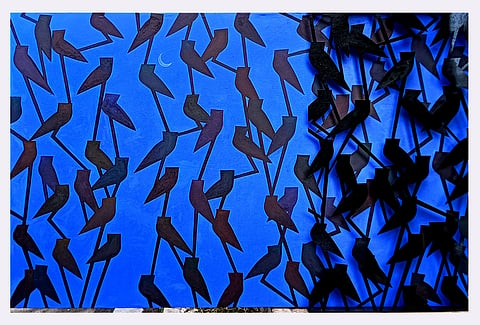

"Humne saari hadein paar kardi hain: we have crossed all limits," notes artist Santanu Dey about his ongoing solo exhibition Silent Spring, currently on view at Shridharani Gallery in Delhi’s Triveni Kala Sangam.
At its core, Dey’s work confronts pressing environmental issues and seeks to raise awareness through artistic expression. He works with a host of materials like paper, e-waste like screws and bolts, wood, aluminium litho-plates, graphite amongst others. His practice interrogates themes such as the unregulated exploitation of natural resources, and the consequences of unchecked consumerism. “I work with ecology, environment, and what is happening in our surroundings. Every day we are doing so many meaningless, unnecessary things in the name of living,” Dey states.
The title of the show draws inspiration from marine biologist Rachel Carson’s seminal book Silent Spring. “For the past few years, I’ve been working with the idea of spring — typically associated with colour, vibrancy, and renewal. But in my work, I don’t depict these things. I focus on how human activity is destroying our environment. Through my art, I want to show what we are doing to our surroundings, what kind of footprints we are leaving behind for future generations. That’s why my spring is silent,” he adds.
In one of the key works in the show ‘Witness’— a series of smaller canvases composed of abstract visuals and layered paper connected by pencil lines — Dey paints a stark portrait of the destruction of the Yamuna River and the stories that surround it. “Everywhere, construction is ongoing. It’s never-ending. One side starts, another stops, then starts again — reconstruction, reconstruction, reconstruction. The cycle doesn’t stop. It tells the story of the Yamuna — a small piece of land that remains, silently observing the chaos. We refuse to see it, to acknowledge it, but something is watching us,” notes Dey. An artist from Kolkata who studied in Baroda and is now based in Delhi, Santanu Dey draws from the diverse urban landscapes he has inhabited. “Each city has its own character — its people, their culture, the way they live, their daily rhythms — everything is different. Every city has its own vibration,” he explains. However, Dey notes a disturbing uniformity creeping in: “I don’t see much difference anymore. Whether it's a metro city or a smaller one, the walls are painted with the same departmental slogans, the same signs of careless development.” His work urges viewers to become more conscious of their actions.
Reflecting on Dey’s second solo with Art Incept, the gallery's founder-director Gayatri Singh observes, “The most important aspect of his work is the diverse use of materials — from leaves, concrete, brick dust, metal, to used aluminium cans. He’s really pushed the boundary in terms of discarded materials. But I also feel he’s become bolder in his expression. He’s not as hesitant; he’s more confident — and he’s figured out a way of bringing hope into what is happening today. That, I think, is very important, because all of us are so busy seeing doom and disaster that hope really matters.”
On view at Shridarani Gallery, Triveni Kala Sangam, Mandi House till September 22, 11 am onwards
