
In 1992, Israeli chemist Raphael Mecholulam discovered a neurotransmitter in the brain. He named it ‘anandamide’, the Sanskrit word for bliss. Its chemical cousin? Tetrahydrocannabinol or THC, the main psychoactive ingredient in cannabis. Anandamide (ANA) inspired the title for writer Karan Madhok’s new book Ananda : An Exploration of Cannabis in India (Aleph).
When Madhok was approached by Aleph to write a book on cannabis, he agreed despite the stigma surrounding the topic, forced by a desire to understand it better. “Cannabis is something that a lot of us have an idea of, but we’re not 100 percent sure what it actually means, what is legal, what is not. Everyone in India knows about it, but nobody really knows the details because no one talks about it openly,” he tells TMS.
The research and writing process took around two years, during which Madhok travelled across several states — including Himachal Pradesh, Uttarakhand, Karnataka, Kerala, as well as the cities of Delhi and Mumbai. These details came up in the book discussion held at India International Centre (IIC), in Delhi, on September 23. The panel, moderated by independent journalist Amritesh Mukherjee, included discussants, Omair Ahmad, novelist and journalist; Dr Khagesh Gautam, professor at Jindal Global Law School; Tripti Tandon, lawyer and drug policy analyst; and Madhok himself.

The criminal code
The book reads — “As an activity closely tied to Indian spirituality, British missionaries in India also disapproved of the use of cannabis.” This was followed by a 3,000-page report on the study of cannabis. On the basis of it, moderate amounts of hemp consumption was declared harmless.
“I was born just a year before the NDPS law,” Madhok writes. The bill for Narcotics Drugs and Psychotropic Substances or the NDPS Act, was passed in 1985. The Act, based on the promises of the 1961 UN Treaty, defines cannabis as — “charas, that is, separated resin”, “ganja, that is, the flowering or the fruiting of tops of the cannabis plant” or “any mixture, with or without any neutral material, of any of the above forms of cannabis or any drinks prepared therefrom”, with the exception of bhaang.
During the discussion, legal expert Dr Gautam argued for decriminalising small quantities. “You can’t become [Colombian drug lord] Pablo Escobar by selling 20 grams of weed,” he noted, adding that India needs clear and consistent standards on the criminalisation of the plant.
Madhok shares data from Visakhapatnam, where nearly 85 percent of the local central jail comprises cannabis offenders, while the larger trafficking networks remain largely untouched. “Cannabis is easy to catch and prosecute because it grows so much in India,” he observes.
Holy herb or hunted crop?
While bhaang (an edible form of cannabis made from the plant’s leaves) is sold at government-licensed shops in cities like Varanasi, the same plant in another form — ganja or charas — can put people behind bars for years.
While quoting Madhok's book, Dr Gautam mentions that in Varanasi, one doesn't necessarily need to wait for festivals like Shravan, Mahashivratri, or Holi. “Bhaang and Shiva go hand in hand with the daily lifestyle of many in Varanasi,” he reads the text. Shops in the city’s old lanes with signboards reading ‘Sarkari Bhaang Ki Dukaan’, government-authorised shops run on licenses, often displaying images of Lord Shiva or the Shivling. Akhadas, the traditional training grounds for wrestlers and martial artists, also form a part of this system. “It is well known that the pehlwans have a daily glass of bhang, mixed with fresh cow milk, to aid their focus concentration for the long day of practice ahead,” he continues, recalling that he has witnessed this himself in Kurukshetra, his hometown.
Speaking about a similar experience, Madhok recounts a visit to a hemp expo, where the plant enjoys the trendy image, unlike other forms of cannabis like charas or ganja. “It is surreal,” the author expresses. “These came from the same farms where police were raiding farmers.”
Breaking myths
Language is another medium of shaping stigma. Unlike the word ‘bhaang’, terms like ‘charas’ or ‘ganja’ immediately trigger fear of crime. “Even I feel guilty just saying those words,” Madhok laughs.
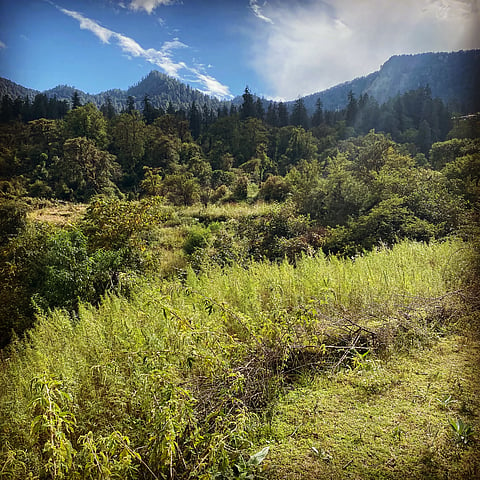
Meanwhile at the discussion, Tandon called it “the greatest irony” that a naturally growing plant is being treated as a criminal substance. “How can you criminalise sun and rain?” she argued, pointing out that cannabis grows wild in many parts of India.
Talking about the medicinal cannabis (cannabis prescribed to relieve the symptoms of medical conditions like epilepsy, chemotherapy-induced nausea, and others) industry in the country, Gautam shares a story about hemp oil helping his mother’s arthritis. “It works,” he said. “There are cancer patients and others who benefit from it.” Madhok adds that even public health experts acknowledge cannabis is less harmful than often believed, though they hesitate to endorse it because “our health system is already overburdened.”
According to him, Cannabis in India is “an incredibly complex issue, and there are no easy answers to this.” Madhok’s book is a subjective exploration of the plant from multiple angles — including insights from experts in medicine, chemical research, and the farmers who cultivate it. Taking examples from India and abroad, he points out that even in countries with progressive cannabis policies, “there’s a lot of debate, a push and pull about it.”
He further advises readers and policymakers to look beyond fear and hearsay, engaging with evidence and expert perspectives to form their own understanding of this controversial plant.