
If India’s post-Independence story can be compared to a castle, it has had its occupiers—lords and families, their household gods, and some burghers with a foot in the door. For its bandits and rebels, there have been guns and oblivion. The records of how freedom was achieved have, in most cases, shown this bias.
Not surprisingly, Rashbehari Bose, Bagha Jatin (the Jugantar chief who had planned an ambitious pan-Indian army mutiny inspired by 1857), and Sachindra Nath Sanyal have been remembered as regional freedom fighters. They have monuments at roundabouts in West Bengal, but few know that they were the core of the first generation of India’s armed revolutionary movement, doing much and being everywhere, from operating as secret societies committed to sabotaging and disrupting British India to becoming a pan-Indian network of militants during World War I working for India’s freedom.

Sanyal, Bose’s deputy, was a Bengali from Varanasi. His only ‘monument’ is the autobiography, Bandi Jeevan (A Life of Captivity), that he left behind. The only other memorialisation is his name among the freedom fighters incarcerated at the Cellular Jail memorial in Port Blair. Bose threw a bomb at a British viceroy; he worked with Sanyal to tie up with other Indian revolutionaries and tried to make the Ghadar revolt take off in India. It failed, but left a deep imprint.
Course correction
Yet the impression is “that their activities neither had any overarching strategy nor any significant impact on the overall struggle for Independence. The reality is that they were part of a large network that sustained armed resistance against the British Empire for half a century”, writes economist and popular historian Sanjeev Sanyal in his 2023 book Revolutionaries: The Other Story of How India Won Its Freedom (HarperCollins).
Sanjeev Sanyal is a grandnephew of Sachindra Nath Sanyal. Prime Video has just unveiled the trailer of its series The Revolutionaries based on Sanyal’s book.
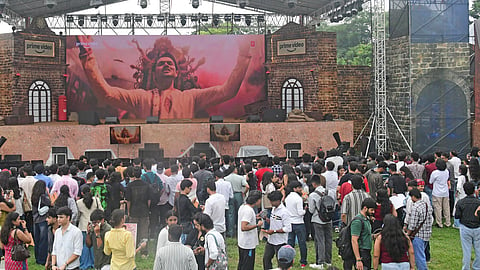
Set to premiere on September 11 on Amazon Prime, Nikkhil Advani has directed Revolutionaries. It stars Bhuvan Bam as Bose, Rohit Saraf as Sanyal, Pratibha Ranta as Pratibha Lahiri – a fictionalised character – and Gurfateh Pirzada as Bagha Jatin. The four lead characters were part of the high-octane trailer launch in Delhi on Wednesday with Fans of Saraf, an Instagram fan page group, active on the ground. Saraf is clearly quite a hit post Dear Zindagi and the Netflix drama Mismatched.
A high-adrenalin series
Flying bullets, cocking revolvers, clouds of vermillion, a woman revolutionary in a red-bordered sari invoking Durga and Kali, car chases, train escapes, secret meetings and midnight knocks, a falling comrade — all played out against a big screen as the sun set over the Sunder Nursery lawns. The series seemed stacked with drama, blood, tragedy, revolutionary hits and misses.
“We won’t just defeat the Brits, we will obliterate them”, “Let us unite as one and unleash Ghadar”, reverberated from the stage as the trailer played on loop. It inadvertently also spoke to the zeitgeist—young people tired of waiting for change.
Bose was in his twenties when he was a lone underground operative, an organiser who was networking with other internationalists in the time of other world revolutions; Bagha Jatin was 35 when he died of gun wounds in Balasore; and Sanyal was in his thirties during the Kakori Conspiracy, with already a term in Andaman when he was 23.
A minor quibble. In the ‘Jai Durga’ track, why have Sanyal and Bagha Jatin stomp the ground like Bollywood heroes? An attention-seeking revolutionary is a revolutionary asking for trouble. But who knows, with OTT now the new cinema, it may just work to add to a period drama. The attempt to make Bose, Sanyal and Bagha Jatin larger than life could also be understandable from the point of view of a series aimed at correcting the lack of spotlight on those on the sidelines of India’s freedom annals.
What may not be known, and one hopes the series will show, is that Sanyal, co-founder of the Hindustan Republican Association, was a mentor of one of India’s most famous second-generation armed revolutionaries – Bhagat Singh, though Singh later made an ideological break by renaming the organisation the Hindustan Republican Socialist Association.
In Sanjeev Sanyal’s book, the passing of the baton is traced in one instance through a personal memento to remind a comrade of an unfinished job. As he leaves India, for the last time, for Japan, Bose gives a pocket watch he had bought “to mark the time of his failed (Ghadar) revolt” to Sanyal. Sanyal eventually gives it to Bhagat Singh, thus effecting, as it were, a handover to a different revolutionary time. For it is with Bhagat Singh’s hanging that the freedom movement decides that the time for petitions is over, and it is time to get Self Rule. Will the series trace all these linkages, one wonders? Otherwise, there is always the book to turn to.