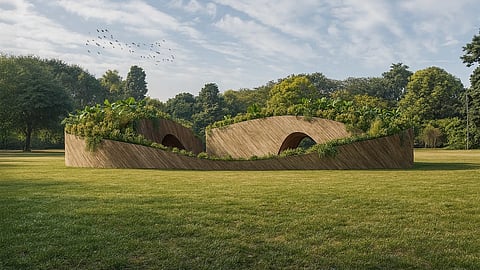

Lantana camara is one of India’s most widespread invasive plants. Environmental conservationist Tara Lal, who is also the founder of the conservation and creative arts initiative ‘Aranyani’, said the plant was brought to India during the Portuguese and British colonial rule as an ornamental shrub. It has since spread aggressively across forests and grasslands, disrupting native ecosystems and threatening biodiversity.
Now here’s a twist to this tale. Always considered a nuisance plant, Lantana is the main structural element of a brand-new public pavillion, titled ‘Sacred Nature’, at one of Delhi’s prime outdoor spots, the Sunder Nursery.
Wild beauty
‘Sacred Nature’, built largely from upcycled Lantana wood, is the inaugural edition of the Aranyani Pavilion, a large-scale ecological art and architecture project conceptualised by Lal. The pavillion opened on February 4 this month, and following a positive reception from the public, its run has been extended until February 20.
Lal said that using Lantana as the primary material was a conscious decision to question how value is assigned within ecological systems. “Invasive species are often framed as the problem,” Lal explained, “but they are responding to conditions we have created. By working with Lantana, the pavillion shifts the conversation from blame to responsibility.”
According to Lal, the process of working with its wood relies on skilled craft and manual labour, acknowledging both the difficulty and potential of engaging with such a material. “Repurposing Lantana does not deny the ecological disruption it represents, but it does ask how we might respond to existing damage with care and intention.”

A walkthrough
Set within the lush green gardens of Sunder Nursery, ‘Sacred Nature' is designed as a spiral walkthrough installation, created in collaboration with London-based architectural studio, T_M.space. The structure has been inspired from natural patterns and indigenous knowledge systems, where the spiral appears in shells, seeds, weather systems and cycles of growth. The inspiration also comes from the sacred groves or the community-protected forests that functioned as early bio-reserves long before modern conservation laws.
“The spiral allows for a gradual orientation rather than a linear narrative,” Lal told TMS. “As visitors walk through the pavillion, there’s a sense of entering a forest while also tuning inward.”
As you enter the pavillion, you find yourself walking between intricately stitched lattice walls, shaped like waves and built from Lantana sticks. Above, a canopy of green foliage and colourful flowers sways lightly. Visitors can slow down, sit for a while, and experience nature at close range.
The visit ends in a room, with a stone monolith placed at its centre — recalling the ritual cores of sacred groves, where stone markers traditionally signified the meeting of earth and sky.
The canopy of more than 40 native plant species, includes flowering and non-flowering plants, as well as edible and medicinal varieties used in North Indian food and healing traditions. Lal said that plant selection was guided by local ecology and by how different species support one another, encouraging pollination and creating habitats for insects and birds.
“Rather than presenting plants as individual specimens, the pavillion treats them as part of a shared system,” Lal explained. “Placing species linked to nourishment, healing, and pollination side by side draws attention to the interdependence that underpins ecological balance, and to our continuing dependence on these relationships for food, health, and survival.”
Nurturing nature
Including early research, material testing, and on-site construction, the project took several months to be fully built. One of the main challenges was working with Lantana’s irregular form, because its uneven shape makes it hard to use in a uniform way. The material required extra adjustment and care, affecting both the pace and the process of building. Another challenge, Lal says, was “sustaining a living canopy of native species through the winter months”, ensuring the plants remained healthy while still conveying the intended density of the structure. “This required close coordination between planting, climate conditions, and construction timelines. The project depended on sustained collaboration between architects, designers, craftspeople, and ecological advisors throughout.”
Unlike many environmental projects that focus on protection or preservation, ‘Sacred Nature’ engages directly with ecological disturbance. “Many landscapes are already altered by human action,” Lal remarked. “Preservation alone cannot address that condition. Working with damaged ecologies shifts the focus from idealised conservation to responsibility as an active practice.”
Conversations around ecology
Alongside the installation, the pavillion has been hosting various programmes like talks, performances, workshops, and guided tours based on the installation’s ecological.
After its presentation at Sunder Nursery, the pavillion will be relocated to the Rajkumari Ratnavati Girls’ School in Jaisalmer, where it will serve as a living classroom within an educational campus shaped by climate-sensitive design. The edible and medicinal plants from the pavillion will be donated to community-led initiatives such as the Basti Gardens of Hope in Nizamuddin.