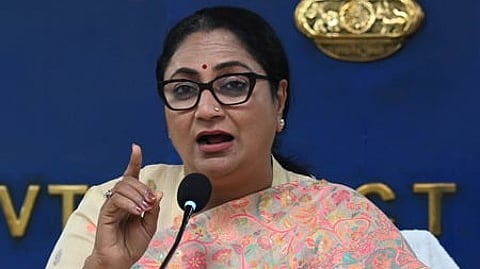

This week, Rekha Gupta would be completing a year in office as the Chief Minister of ‘half-state’ of Delhi, uniquely referred to as National Capital Territory (NCT). Delhi, being the national capital, is also country’s showcase city, whose administration presents a case study in the mechanics of urban governance under a unique framework.
The governance framework of the Capital provides for multiplicity of authorities, with the Delhi government playing the pivot role of coordinating with all organs of governance. A confrontation between various government agencies is catastrophic for the administration, and this was voluminously illustrated during the 10-year AAP regime in the Delhi Secretariat.
Delhi’s constitutional status has created a governance environment that demands negotiation as much as execution. Gupta’s emphasis on coordination with the Union government shows her recognition of this structural reality. It may also be pointed out that Gupta is lucky that she heads the government of a political party that also helms the Union government.
Aligning activities of municipal, state and Central agencies is the best survival strategy in Delhi’s fragmented administrative ecosystem. However, the effectiveness of such alignment has to be judged less by political harmony and more by output. While inter-governmental friction has reduced, the positive fallout of this harmony can only be quantified by the execution of various projects meeting timelines and optimum use of the budget.
The rollout of electric buses and expansion of school infrastructure form the most visible markers of activity. The electrification of public transport aligns with both environmental and service-delivery goals.
However, this fleet augmentation has not necessarily come with an effective distribution of bus routes. Herein lies the real challenge, as the drawing of bus routes and deployment of fleet need coordination between various departments. The proposal for a Unified Metropolitan Transport Authority, if realised, could bring panacea for the ailing bus service system.
Likewise, additions to school infrastructure and ICT laboratories represent capacity investments. Their long-term impact will depend on pedagogical adaptation, teacher training and curriculum integration. Infrastructure without operational transformation often yields diminishing returns.
Gupta’s characterisation of air pollution and river degradation as “legacy problems” may be factually correct. Yet, politically, its early resolution is necessary. The administration’s focus on expanding monitoring infrastructure is welcome as measurement precedes management. Denser AQI monitoring networks can sharpen policy targeting. However, the government this winter faulted giving people expectation of bringing artificial rains to fight pollution. If the government has realised that the solutions have to be more grounded, good for it.
The Yamuna clean-up has been on for several decades and has its own complexities. River rejuvenation depends on flow from upstream, sewage treatment capacity and land-use enforcement. Progress is slow.
The AAP government ran on the fuel of social welfare schemes. It was claimed that these schemes left the treasury no money for development works. Now, the Gupta government has to retain or reshape these schemes while keeping fiscal sustainability in mind.
The expansion of health and welfare card distribution highlights the administration’s redistributive priorities. Their success rests on targeting accuracy and fiscal sustainability. Delhi’s relatively strong revenue base offers some buffer, yet medium-term sustainability will require disciplined expenditure and continuous survey of the scheme reaching the beneficiary groups.
A few recent instances involving civic safety failures underscore the biggest challenge of overcoming oversights in the implementation of development projects. Accidents often show process failures. Sustained improvements depend on institutionalising compliance mechanisms.
Gupta has claimed that the first year was of foundational work. However, in the same vein she has also to decide on a timeline for delivery of projects. The administration’s challenge entering its second year is that governance gains must become visible.