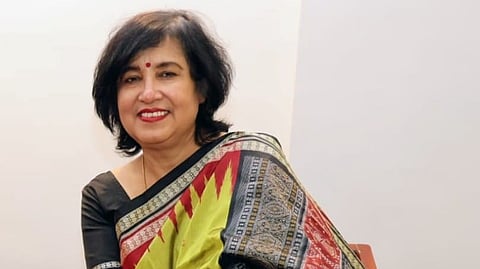

Just a day after flying in from New York, Bangladeshi author Taslima Nasrin sits through her session at the Kerala Legislature International Book Festival and then settles down for a nearly two-hour interview. She says she likes collecting photographs from places where people value her. Raised as an atheist by her father, Nasrin recalls reading the Quran in Arabic without understanding it. When she read it in Bengali, she found its tenets oppressive to women. A doctor by profession, she chose to speak up — a decision that turned her life into a whirlwind after she was exiled from Bangladesh. As Bangladesh is set for a new era after the general elections, we present excerpts from an interaction:
Will elections in Bangladesh change the situation there?
There is some hope, though I don’t know how much. One day, people in Bangladesh will tire of Islamic laws and revolt, like in Iran, where people now say: ‘We are not a Muslim nation, we are Persians. And we don’t want Islamic laws.’
How do you view Muhammad Yunus, once seen as a Nobel Peace Prize icon?
He is a fundamentalist. I think he is like Aung San Suu Kyi or Henry Kissinger — peace prize winners who later proved harmful. Mob violence has been going on for a year, and he does not care.
You have donned many roles: doctor, author, activist… which one do you identify with most?
None. I just want to be called an honest person. Just a human being. But I am not accepted — neither in Bengal nor in Bangladesh. The Left government of West Bengal banned me in 2003. But now the Left Front government honours me in Kerala. Why? I am the same person.
What do you think explains this paradox?
I believe in the Left ideology of equal rights for all. But I don’t know why they opposed ‘Dwikhandito’, the third part of my autobiography. The West Bengal government had banned it because I wrote against the idea of Islam as a state religion. Ganashakti, the Left newspaper, wrote extensively against ‘Lajja’. Only one person — E M S Namboodiripad — wrote in my support, in ‘People’s Democracy’.
How are you received in West Bengal today?
[Chief Minister] Mamata Banerjee banned my TV series. I want to be in Kolkata as I am Bengali and belong to that culture. But she won’t allow it.
Bangladesh was once a hub of Bengali intellect. What changed?
After Partition, many Hindus left the land. It became a Muslim-majority state. Initially, Hindus made up about 30 per cent of the population. Now it is only around 8 per cent.

Are you implying that a Muslim majority changes the character of the land?
Of course. The kind of education the Muslim majority receives also plays a role. Governments used religion for their own interests, allowing mosques and madrasas to come up everywhere, where sectarianism was taught. Sermons containing anti-Hindu and anti–non-Muslim hate were allowed. As a result, Hindus and Buddhists were attacked. Every leader did this — (Hussain Muhammad) Ershad, Khaleda Zia, even (Sheikh) Hasina. She built 560 model mosques. Why do you need so many?
Bangladesh was culturally rich. Fundamentalists occupied the country with the help of successive governments. Muhammad Yunus did not destroy the country one day; the destruction was already in process.
Bangladesh has had women leaders….
That is dynastic politics. Nothing more. Women have no real rights. Dynasties put Sheikh Hasina, Khaleda Zia, and Roshan Ershad in power. Dynastic politics must end.
You had backed the CAA…
I want it extended to free thinkers and writers banned in countries like Bangladesh and Pakistan. Many of us carry Muslim names but are atheists. We were forced out for opposing Islamic laws. From abroad, we speak against violence — against fanatics burning Hindu homes to seize land.
You have been called a Hindutva supporter…
That is propaganda by jihadis. Whenever I criticise Islam, they brand me a R&AW agent or a BJP–RSS supporter. This is common, especially when I speak about Muslim women’s rights.
Many women now speak up for women’s rights. Will things change?
Change is happening. Women may be wearing burqas, but they are getting educated and working. It is slow, but it is happening. At the same time, fundamentalism is growing. Free thinkers must challenge the idea that Islam is exempt from criticism. It must reform.
Has writing been a liberating experience for you?
Writers cannot bring about revolution overnight. But some people have changed their ideas because of my work. Some extremists have become liberal. Writing can influence governments too, but it takes time. Good books can influence. Religious fanatics, however, read only one book.
(With inputs from Anil S and Parvana K B)