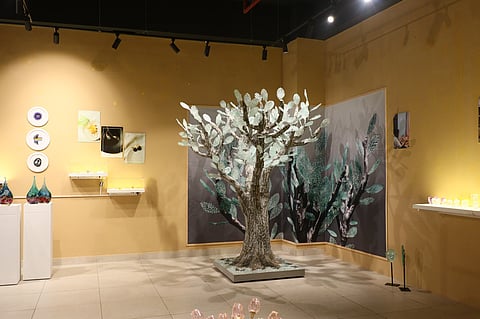

Glass as a medium of art has roots in early Egyptian and Mesopotamian civilisations. Though an irreplaceable structural element in ancient Indian architecture and design and in contemporary household accessories as well, glass artists say the pursuit of their art comes with many challenges.
‘The Alchemy of Glass’, an India Art Fair Parallel exhibition at The Kunj, was a showcase of the work of celebrated glass artists Anuj Poddar, Asad Hajeebhoy, Hemi Bawa, Saira Zoya, Mubin Khan, Narinder Singh Bais, Rajesh Sharma, Reshmi Dey, Revati Jayakrishna, and Vishnu Kushwa.
Alchemy is the process of turning base matter into something precious through knowledge, patience, and imagination. It is both a material practice and a poetic idea, where science meets intuition and effort yields meaning. Revati Jayakrishna, who practises glass fusing using the Moti Bharat craft, said while speaking to TMS: "Working with glass is physics, chemistry, and maths tucked in art. The knowledge of the right temperature, material, and heat component is a must."

Know the chemistry
The shrinkage of the material, correct heat, and type of glass that would expand and contract according to the need of the subject matter are at the core of the craft. The artists highlighted the importance of knowing the chemistry of the medium before creating a piece; otherwise, they said it's another failed attempt that would be scrapped.
Poddar uses carving techniques to create pieces that explore themes of kinship, memory, and human connection. He also highlighted the science behind the art form: "Colour transforms glass into a living object. A blue pane at dawn is not the same blue at dusk. Artificial light alters it again. The sculpture changes with the weather, the hour, and the season. It is never static. This fluidity is what draws many artisans to the medium," he said.
Glass’s fourth dimension
Talking about his glass sculptures on display at the exhibition, Poddar said that at first glance, while they may appear as three-dimensional figures, he believed in their fourth dimension, “which is their interiority – you can see within."
Glass as a medium is both fragile and stubborn. The exhibition showcased pieces, some of which took months to take shape, and some were made in just five minutes under the same roof. The glass-works in the exhibition revealed the delicate balance between fragility and strength, tradition and experimentation. Whether it be the dolphin cocktail stirrer or a tree of life or glass jewellery, the collection bore witness to an age-old process in which raw material is transmuted through heat, skill, and time, featuring artisans from Firozabad, Baroda, Faridabad, Sonipat, and Goa.
Ashwini Pai Bahadur, director of The Glass Makers Club, said that the exhibition is an attempt at celebrating the richness, diversity, and evolving signatures of studio glass practice in India. "Glass as a medium is as magical as it is unforgiving, with only a few individuals leading the way, and hence it deserves more attention and support."
In Europe and in China one can get ready-made blocks of glass. "But here, we don’t have that option, so we have to create our own blocks. I use thick glass pieces, stick them together with glue, and then carve into them," said Poddar.
Glass is less like a material and more like an instinct that is shaped by pressure and transformed by fire. The craft is in the fine balance.
The exhibition is being organised in association with the Office of the Development Commissioner (Handicrafts) and the Ministry of Textiles. It will be on display till February 24.