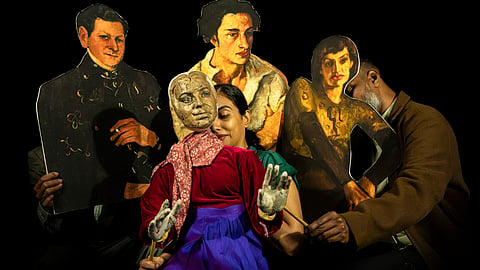

What do you say about a woman who lived only for 28 years, defied conventions, and redefined the course of modern Indian art? In the play, Amrita Sher-Gil: A Life Lived, puppeteer and founder of The Ishara Puppet Theatre Trust, Dadi Pudumjee attempts to tell the artist’s short but extraordinary life story — through her perspective.
Set to be staged on February 22 at 4 pm and then at 7:30 pm, at the Stein Auditorium, India Habitat Centre, the play is a ‘puppet-cum-theatre’ show, using various props, puppets, music, and poetry to explore Sher-Gil’s journey.
The concept came about as part of the yearly production of new work by the Ishara Puppet Theatre Trust. “We were thinking of something to do with colour, with art, something that projects design,” he tells TMS. “That’s when the idea of Amrita Sher-Gil came up.”
An extensive research went into the making of the script, dipping into letters, diaries, biographies and archival material, including Yashodhara Dalmia’s Amrita Sher-Gil: A Life, and those preserved by the Sher-Gil Sundaram Arts Foundation, set up by the late Vivan Sundaram — a contemporary artist himself and Sher-Gil’s nephew — and art critic Geeta Kapur. A lot of the text is based on Amrita’s own words. The difficulty was in compressing her big life into a small production, says Pudumjee.
What makes this play special is that, instead of presenting a chronological biography — “this happened, then that happened” — the production brings together puppets, actors, music and movement. Pudumjee describes it as a “synergisation” form.

Know her life
Sher-Gil was born on January 30, 1913, in Budapest, to Umrao Singh Sher-Gil and Marie Antoinette Sher-Gil. Umaro, one of the pioneers of photography in India, was from an aristocratic family in Punjab; Marie was a Hungarian opera singer.
At 16, Sher-Gil enrolled at the École des Beaux-Arts in Paris. She returned to India in 1934; her early works reflect her academic and modernist training in Paris. Among her European-themed works are ‘Self-Portrait with Easel (1930)’, ‘Girl in Mauve (1931)’, and ‘Hungarian Gypsy Girl (1932)’. Some of her well-known India-inspired paintings include the celebrated ‘Group of Three Girls (1935)’, ‘Brahmacharis (1937)’, and ‘Hill Scene (1938)’.
In 1941, she moved to Lahore with her husband. There, she fell ill and passed away the same year. Her last unfinished painting, ‘On the Roof’, depicts a rural scene viewed from a terrace.
An unconventional spirit
In this play, a number of elements have been put together to express Sher-Gil’s bicultural identity. Sher-Gil often found herself perceived as European in India and exotic in Europe. This dual identity has been depicted with the help of music and textiles. For instance, Hungarian textile patterns intertwine with Punjabi phulkari designs; the play makes room for Western classical music and Punjabi music as well.
Sher-Gil’s rebellious spirit has been presented in the play. Pudumjee recalls how she was expelled from school in Shimla and Florence (where she studied before enrolling in the art school in Paris). “What is amazing for all of us is that a girl who lived for only 28 years, was so clear and so focused,” he says. “She critiqued her own work in her diaries.” Pudumjee also mentions one of the artist’s letters to her parents where she clarifies that she did not say she disbelieved in God, but only that she did not believe in rigid rituals.
Fight for recognition
Pudumjee also talks about the larger state of puppetry in India. Despite its rich traditions across Rajasthan, West Bengal, Andhra Pradesh, Tamil Nadu and Karnataka, he says the art form is under-recognised. “When academies give awards, puppetry is in the last rung,” he notes. “If dance can have many styles acknowledged, puppetry also has many styles and techniques.”
At the same time, he believes the art form survives because it evolves. Young artists from traditional puppeteering families are always open to experimenting with new materials and stories. This keeps the tradition alive, he adds.