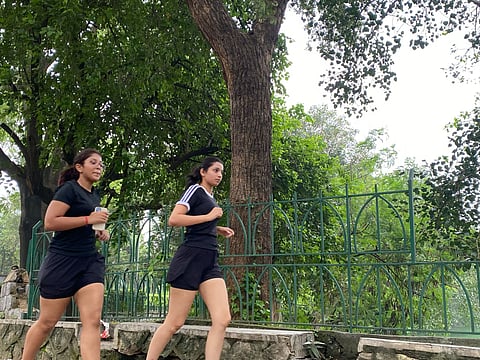

In Delhi, community often begins with a shared table, a shared book, and as it turns out, with a shared run. Delhi Run Collective (DRC) is one such community that has been shaping the city’s youth-driven running culture for the past two years. Launched by Shahnil Samantara, Manraj Singh and Krishna Lohiya — bonded by a shared interest in running —their first Instagram-posted run drew 10 people.
Their Sunday runs now see close to 100 participants, mostly working professionals between 25 and 30. “A running community already existed with those preparing for marathons usually in their 40s and 50s. But younger people didn’t really have an outlet,” says Samantara. “So when ten showed up, I knew there was a need for it.”
Unlike traditional marathon groups focused on pace charts and race timings, many of these newer collectives prioritise consistency and community. Most runs take place across the city’s roads and public parks such as Nehru Park, Lodhi Garden, and Deer Park.
Older groups continue to anchor the serious running ecosystem. Delhi Runners Group (DRG), founded in 2013, remains a space for both competitive marathoners and casual runners; 50 to 60 runners show up weekly. “We have people who want to race strong marathons, and those who want to run without a specific goal,” says coach Alfredo Miranda. Summer is not a deterrent.
Bhaag Club (founded in 2024) and New Delhi Road Runners (2017) are other groups. Global brands like the New Balance Run Club, Skechers Running Club, and Adidas Running Squad, are also part of the scene. The city’s race calendar is also packed—from Cognizant New Delhi Marathon scheduled for this Sunday, Pinkathon, on March 8, and the Vedanta Delhi Half Marathon in October 18.

Friendship making
For a generation navigating long work hours and shrinking social circles, these runs are becoming what sociologists describe as a “third place” — spaces outside home and office where communities form.
Fine arts student Mohit Solanki says running in a group feels less like training and more like gathering. “When we run in a group, it’s about company, fun, pushing each other, post-run meals and banter — it becomes a hangout.”
Roktim Chakraborty, 29, says running has restructured his weekends. “My previously ‘boring Sundays’ turned into long-run Sundays — something I look forward to. There’s a different kind of satisfaction in starting your day early and finishing a long run before most people are even awake.”
Friendships, however, aren’t limited to the young. Surjanu Chaudhari, 42, a marathoner says running clubs have made it easier for older participants to build connections too. As people move into their mid-30s and 40s, he explains, forming new friendships becomes harder. The sessions, he says remove the awkwardness of forced networking. “I’m not someone who will walk up to strangers and start conversations,” he says. “Running becomes a natural ice-breaker.”
Women and safety
The sports and fitness space has long been male-dominated. So where do women find comfort? In 2024, Juby George founded Trail Femmes, India’s women-only trail running club. Began with just four women heading out for trail runs, the club now welcomes walkers, hikers and runners of all abilities with regular monthly community connects. George recalls often being one of the very few women in early running groups. “In trail running communities, the language is almost always ‘he’ and ‘his’. There isn’t much representation, and especially in ultra-trail events, you don’t see many women,” she says.
Delhi Run Collective launched a women-only vertical in December 2025, managed by Soumya Singh. “While fewer in number, women are no less motivated,” she says.
The women-only runs, both George and Singh say, create a “safe space” that allow conversations — about career breaks, motherhood, menopause, injuries, or simply beginner anxieties — that rarely happen in mixed groups. “Many women are just getting started. They feel more comfortable asking questions in the company of other women.”
Nidhi Gupta, 49, has been running for over a decade. “Earlier, women were far fewer in 10K, 21K and 42K races. I see that changing,” she says. “I used to start training between 3-4am. It was dark, but I learned to trust my strength.” While concerns around safety persist in any public space, many say running communities feel supportive, particularly when organised and structured.
Dating on the run
Running spaces are also becoming lower-pressure dating environments. Qurkle, an AI-based dating platform from Gurugram founded earlier last year, by Shubham Muthreja, Kshitiz Agarwal and Aryan Sharma, organised a Valentine’s Day social run for young participants. “Gen Z is more health and fitness conscious, which is why we chose this format,” says co-founder Shubham Muthreja.
Unlike conventional mixers and blind dates, the event combined short runs with interactive games. “If you don’t connect romantically, at least you had a run and a good conversation,” says Sharma. “When people engage in activities together, it feels like childhood again — friendships and banter flow more easily than in formal dating setups.”
Health or signalling?
Gupta says connecting through fitness isn’t a bad idea. Beyond friendship and dating, running reflects a larger cultural shift shaped by growing health awareness. Instagram and tracking platforms like Strava have made marathons and running more visible and aspirational.
“Running is low maintenance. I can do it on a hectic weekday or a relaxed Sunday. It fits into my life instead of demanding that I reorganise everything around it,” says corporate lawyer Sarthak Mishra, 27.
Tattoo artist Fifi, 25 says, “Much of my work revolves around sitting at my desk. I want to keep moving and maintain that momentum so that when I grow older, I don’t face health problems as our parents do.” Having participated in several city marathons, for her, running is both preventive care and preparation for the future.