
In Santiniketan, before plastic sheets became commonplace, clay sculptures were kept alive under damp jute sacks. That is where Kiran Dixit Thacker learned what commitment to art really meant, not through theory or rhetoric, but through daily labour, patience and care.
As a young student, she and her friend Monimal Dev Burmen prepared clay for Ramkinkar Baij, one of the pioneers of modern Indian sculpture, lovingly covering his works so they would not crack in the heat. They travelled with him to local zamindar houses, watched him shape figures with a knife and batten, and absorbed lessons that would quietly define the rest of her life. Burmen sang Rabindra Sangeet while Baij worked. Art, for Thacker, entered not as spectacle but as a lively rhythm.
The work of decades
Today, that rhythm finds a new audience in Delhi. Kiran Dixit Thacker’s sculptures, drawings and paintings will be on view at the Visual Arts Gallery, India Habitat Centre, from March 2-9. The week-long exhibition, ‘Our Ashram…Shantiniketan’ brings together over a hundred works spanning decades, materials and geographies, tracing her lifelong engagement with the landscape, people and spirit of Santiniketan. Moving effortlessly between bronze, mild steel, stone, watercolour, painting and drawing, the show offers an immersive encounter with an oeuvre that is both expansive and deeply grounded.
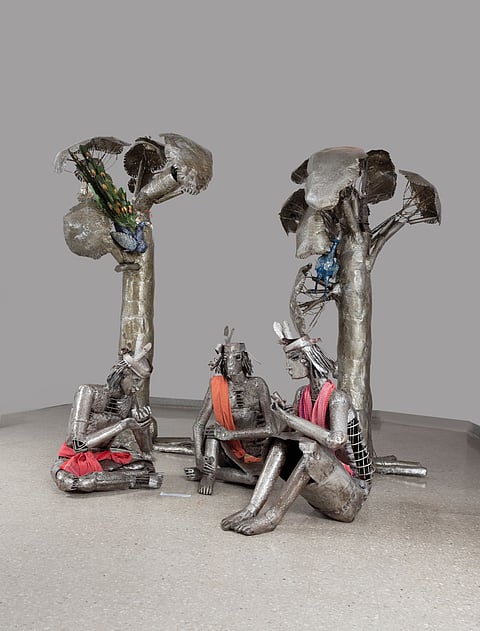
Thacker, 79, is the only living female disciple of Baij, and her practice carries the weight of that lineage without ever being trapped by it. Rooted firmly in figurative sculpture, her work is informed by geometric clarity and a rigorous armature that gives strength and confidence to her surfaces. Many of the watercolours, paintings and drawings on display were produced during her years in London, while the bronze, stone and mild steel sculptures were made in her Santiniketan studio. Standout works such as ‘The Goat’, ‘Three Santhal Men’, ‘Woman with her Hens Cocks’, towering palm trees animated by peacocks, and sensitive bronzes like ‘Owls’, ‘Lovers’ and ‘Monkeys' are a testament to her craft.
When in Santiniketan
Santiniketan shaped her early thinking irrevocably. Drawing was non-negotiable. Students were not allowed to begin any work without sketching until structure was understood. An old skeleton in the sculpture department served as a constant reminder that form must be earned. Even without formal life-drawing classes, sketchbooks were always full. Teachers were present, demanding and generous, guiding students to see before they attempted to express.
One lesson remains emblematic. When a senior teacher returned from Japan with exquisite scrolls, Thacker asked to learn the technique. Instead of instruction, she was asked to bring 12 small green sketchbooks filled with compositions. Only then was she taught how to hold the brush “like the Japanese.” The lotus scroll she produced was beautiful, later stolen, but the discipline behind it stayed.
That discipline travelled with her to London, where she trained in design and technology and later taught for 28 years in British state high schools. Those years refined her relationship with materials, especially metal.
Choosing her metal
Bronze, though beloved, became increasingly expensive and unforgiving. Even a small mistake could ruin months of work. It was then that mild steel entered her practice, not as compromise, but as opportunity. Influenced deeply by the sculptor and printmaker Somnath Hore – a close associate of Baij and head of Santiniketan’s printmaking department – and his method of direct modelling in wax, Thacker began translating tactile, immediate processes into steel. She built armatures from steel rods, clad them with sheet metal, and treated the surface with the same sensitivity she once reserved for wax and clay.
“There are no hard rules,” she says. “Ducks and doves are crafted in bronze, langurs remain in steel. Materials respond to ideas, not the other way around.”
Her themes remain steadfast: village life, tribal communities, animals, trees, ponds. Before sculpting ducks, she sketched them at the local village pond. Santiniketan, with its Santhal villages, goats, trees and slow seasons, offers her what cities never could. “I am not a city person,” she admits. “Here, inspiration is at my doorstep.”
Despite personal hardships, her work radiates a quiet joy. Determined lines, playful forms and resilient figures speak of an artist who absorbs influence like blotting paper but releases only what she understands. “My work is mine,” she insists. “Why copy and reproduce second-hand ideas?”
That belief has run throughout her career; firm, final, unambiguous.
‘Our Ashram… Santiniketan’ invites audiences to encounter an artist whose practice bridges memory, place and craft with rare integrity. This exhibition is not just a survey of works but a portrait of an artistic life shaped by discipline, material intelligence and an unshakeable faith in originality. In an age of easy replication, Kiran Dixit Thacker’s work stands as a reminder that original craftsmanship demands time, attention and the courage to end every sentence on one’s own terms.