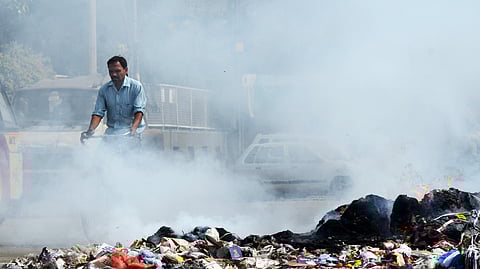

NEW DELHI: Delhi continues to face a severe garbage crisis, driven by years of weak waste management practices, rapid population growth, and rising consumption. Thousands of tonnes of waste is generated daily, much of which still ends up at overstretched landfill sites, such as Ghazipur, Bhalswa, and Okhla.
While deadlines have been announced to flatten garbage mounds, people want visible and permanent solutions, including zero dumping near residential areas and the complete elimination of open waste heaps.
The Delhi government needs to shift its focus from short-term claims to sustained, outcome-driven action. The top priority should be ensuring that fresh garbage does not reach landfill sites. This requires strengthening door-to-door waste collection, with strict enforcement of waste segregation at source.
Households must be made to separate wet, dry, and hazardous waste, supported by a clear and closely monitored collection system. Without proper segregation, recycling and scientific processing will remain ineffective.
Another area demanding attention is decentralised waste management. Instead of transporting mixed waste over long distances, the government should scale up composting units and material recovery facilities at the ward and zone levels.
Treating waste closer to its source will reduce pressure on landfills, cut transportation costs, and improve recycling efficiency. Wet waste should be mandatorily processed into compost, while dry waste must be channelled to authorised recyclers through a transparent mechanism.
The government must also intensify efforts to scientifically deal with legacy waste at Ghazipur, Bhalswa, and Okhla. Biomining operations need faster execution, higher daily processing capacity, and round-the-clock work schedules. Contractors should be held strictly accountable to timelines, with penalties imposed for delays.
Construction and demolition (C&D) waste management requires tighter monitoring. The government should ensure that all construction sites are registered with designated agencies and that debris is disposed of only at authorised facilities. Illegal dumping of C&D waste on roadsides, drains, and vacant plots must attract heavy penalties.
Waste-to-energy operations also need sharper oversight. The government should ensure that only non-recyclable waste reaches these plants, while recyclable material is diverted earlier in the waste management chain. Continuous monitoring of emissions and strict compliance with environmental norms must be non-negotiable.
Garbage problem cannot be solved by machinery alone. What people expect is a clear roadmap, strict enforcement, strong inter-agency coordination, and consistent follow-up. The government must focus on preventing waste generation, managing it scientifically at every stage and ensuring that no neighbourhood becomes a dumping ground again.