
In 1926, a few years after New Delhi was declared the imperial capital, the East Indian Railway Company sanctioned a railway facility between Ajmeri Gate and Paharganj with just one platform. This came to be known as New Delhi Railway Station.
As years passed by, the modest structure found meaning in concrete and cement, with expansion plans taking shape. It now stands at the heart of the city, neatly dividing Lutyens’ New Delhi with the old Delhi as one of the busiest junctions in the country.
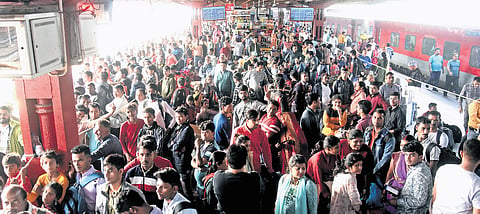
Its 16 platforms and 18 tracks have one factor that binds them—chaos. And, in that sense, the station belongs more to the old than to the new. ‘Sirji, Madamji, gaadi nikal jayegi traffic ki wajah se…’ (Sir/madam, you will miss the train because of traffic), and the obvious, anxious glances at ticking clocks—that’s how the station greets you.
For thousands of passengers approaching the New Delhi Railway Station from the Paharganj side, the journey does not begin with the whistle of a departing train but in a gridlock of unmoving traffic, with porters knocking at the car windows to pick up luggage.
Many governments planned to redevelop the station, relocate and restructure it but nothing changed. The chaos exists. The passengers are still struggling to find a hassle-free way to the station. Once again, redevelopment plans are afoot in a bid to reduce the daily disorder.

Two tales of chaos
Barely 200–300 metres from Platform 1, taxis and auto-rickshaws grind to a halt, trapped in a tangle of encroached footpaths, illegal parking, and roadside markets spilling into what little road space remains. What should be a five-minute drive routinely stretches into a half-hour wait. Often, passengers are left with no choice but to walk. This is Paharganj. And for many, reaching New Delhi Railway Station from this side feels like a test of endurance before the actual journey even begins.
The Ajmeri Gate side (Gate number 2), home to Platform 16, paints no different picture. It offers a slightly wider approach road and marginally better traffic flow on weekdays, but on weekends, it transforms into another bottleneck.
Parking is the biggest challenge at this site. Private vehicles dropping passengers are often charged `150 just to enter the station area, even for a brief stop. Autos line up haphazardly. Hundreds of porters cluster near the entrance, calling out to passengers dragging their suitcases. Before even reaching the station building, passengers must endure long security queues. These queues can stretch up to 200 metres during peak travel days. Digital baggage scanners become choke points.
In this chaos, porters operate with remarkable efficiency. They lift bags over scanners, navigate around queues, and guide passengers through invisible shortcuts. The price, however, is steep. A porter charges between `600 and 700 to take a passenger from Ajmeri Gate to Platform 4 and around `500 from the Paharganj side to reach Platform 1. They don’t wait for trains to arrive; their job ends at the platform.
“There is no real regulation. Everyone knows this is happening, but no one stops it,” said a senior citizen travelling with his wife.
Redevelopment: A promise of order
After two failed attempts in 2001–02 and 2008–09, the long-awaited redevelopment of New Delhi Railway Station is being planned. It received Cabinet approval in 2022. In September that year, the Union Cabinet sanctioned `10,000 crore for the redevelopment of three major stations—New Delhi, Ahmedabad, and Chhatrapati Shivaji Maharaj Terminus in Mumbai.
The New Delhi project envisioned a complete transformation: twin dome-shaped station buildings, modern facilities, seamless integration with city transport, and the capacity to handle future passenger growth. However, the road to redevelopment has been anything but smooth. In May 2023, the tender for NDLS was discharged after bidders quoted costs far higher than the approved amount. The Rail Land Development Authority (RLDA) subsequently reduced the scope of work and issued a fresh tender – its fourth attempt – in July 2023, pegging the estimated cost at Rs 4,700 crore.
Despite setbacks, railway officials insist the vision remains intact.
Two new stations, one integrated hub
According to Northern Railway’s chief public relations officer, Himanshu Shekhar Upadhyay, the redevelopment aims to change how passengers experience the station.
The CPRO said, “Stations are being designed with consideration of world-class modern amenities, seamless entry and exit to the station, segregation of arrival and departure passengers, and integration with other modes of transportation for the ease of passengers.
Sufficient numbers of vertical circulation elements, such as escalators, lifts, etc., are provided for facilitating public movement. Modern information display boards are provided for the information of passengers. An automatic fire alarm system and a firefighting system have been considered for emergency preparedness.
He added, “The redevelopment plan for New Delhi Railway Station envisages a complete overhaul of its existing infrastructure. Two new station buildings will be constructed alongside Platforms 1 and 16, replacing the current structures. Together, the new buildings will offer about 1.09 lakh square metres of built-up area, a sharp increase from the existing 17,274 sqm.”
Currently handling around four lakh passengers daily, the redeveloped station is designed to accommodate up to seven lakh passengers a day. He added the new facilities will include dedicated holding areas, apron zones to enable smooth passenger movement from elevated roads into the station, retail spaces, and parking facilities. The project also plans seamless integration with multiple modes of city transport, including the metro.
A station under strain
The New Delhi Railway Station is immense handles the daily pressure of around four lakh passengers every day. Older studies suggest this number is even higher.
A detailed productivity report prepared in 2018 by an architect and transport planner Rohit Anand and a professor from the School of Planning and Architecture Sanjay Gupta had highlighted the scale of the problem. Using video-based passenger counts across eight entry and exit points—four each on the Paharganj and Ajmeri Gate sides—the study estimated daily count of around 0.48 million passengers in 2018.
A total of around 36,000 passengers enter and exit the station in peak hours, out of which Paharganj and Ajmeri Gate sides contribute 40% and 60% share respectively. By applying a peak hour factor of 7.45% of 24 hours footfalls (NDLS redevelopment report 2008). The report projected that by 2026, daily footfalls could touch half a million passengers or more.
Yet, the infrastructure has barely kept pace.
The study flagged several chronic issues: Absence of adequate hold-up areas for crowd management; lesser space provided at island platforms as compared to side platforms; large amount of luggage carried by passengers (on an average, one bag per person) etc.
The study had also concluded that railway stations in India have poor handling capacity of passengers compared to European stations. There are gaps in the use of land resources available for infrastructure development such as area under operations, and buildings are under-utilised as compared to permissible norms.
After evaluating all these proposed scenarios, it has been found that case station productivity can be improved by adopting the strategies in the paper. Further the study also observed that the city-side transport system from the station to different parts is greatly neglected by the railway station planners and should get the right priority by providing requisite public transport services, integration and adequate parking facilities. In addition it is proposed that air space over stations need to be utilized for value capture by developing commercial or mixed-use development based on PPP mode.
Waiting for relief
For now, passengers continue to navigate the daily chaos – dragging suitcases through broken pavements, bargaining with porters, and racing against time just to reach their platforms.
Back in Paharganj, the family that stepped out of the taxi finally reaches the station entrance, slightly breathless but relieved. Their train is still there. For millions of others, the experience is similar—a reminder that at NDLS, the most exhausting leg of the journey often lies just outside its gates.
Whether the redevelopment brings a change to this daily ordeal, remains to be seen. But for those trudging the last 300 metres today, the hope is simple: that someday, reaching the station will no longer feel harder than leaving the city.
The power of organised labour
During the historic 1974 nationwide railway strike in India, New Delhi Railway Station (NDLS) was effectively paralysed, as railway workers joined the industrial action led by the All India Railwaymen’s Federation under George Fernandes. Beginning in early May, trains at NDLS came to a complete halt, reflecting the station’s central role in India’s passenger network. While no iconic speeches were delivered on the station platforms, New Delhi hosted key union meetings, and several union leaders were arrested in the city, linking the capital directly to the political dimension of the strike. The shutdown at NDLS and other major hubs highlighted the power of organised labour, drew national political attention, and contributed to the growing tensions that eventually preceded the Emergency in 1975, making NDLS a critical flashpoint in the intersection of industrial action and political history.
Construction & traffic blocks
As redevelopment plans appear to be in action under the Amrit Bharat Station Scheme, the common man had to get inconvenienced as traffic advisories were issued, and people were told to avoid unnecessary movement around the station’s Gate No. 1 at Paharganj side on the Chelmsford Road due to construction activities. Two new station buildings are set to be constructed alongside Platforms 1 and 16, replacing the current structures.
A STAMPEDE that crushed 18 lives
At least 18 people—including nine women, four men and four children—were killed and more than a dozen injured in a deadly stampede at the New Delhi Railway Station on 15 February 2025. The stampede broke out around 10 pm as thousands of devotees bound for the Maha Kumbh Mela at Prayagraj were waiting for their trains at platforms 14 and 15 of New Delhi Railway Station. The stampede triggered major panic among fellow travellers. An incorrect platform change announcement was found to have triggered the stampede during an initial analysis of the incident. Poor crowd management was also considered a key factor that contributed to the stampede. Later in August, Railway Minister Ashwini Vaishnaw responded to a parliamentary query by a Samajwadi Party MP, saying that the cause of the stampede was a large headload that fell from a passenger.
Metro network saves the day?
Amidst the never ending chaos surrounding the station, the New Delhi metro station eases the tedious commute to the station. Started in 2022, the ND metro station is connected by the yellow line and the orange line (airport line), making it easy for people headed to airports. The metro station and the railway station is connected by a 240 metre long skywalk, situated on the Ajmeri Gate side of the station. The skywalk also connects to the multi-level parking across Bhavbhuti Marg.