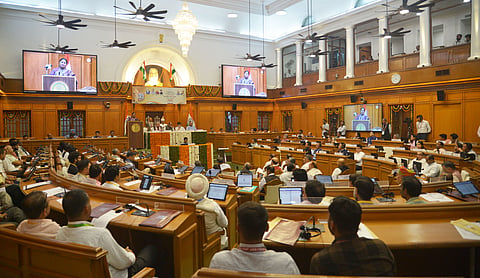

The winter session of the Delhi Assembly is set to begin on Monday, and with it arrives an opportunity, perhaps even a test for the government and the Opposition. As per protocol, this being the first session of the calendar year, the Lieutenant Governor will address the House, outlining the vision and roadmap for the capital in the coming months.
This address is not meant to be ceremonial alone. It is intended to set direction, define priorities, and offer clarity on how the administration intends to confront Delhi’s growing governance challenges. Following the address, the House will take up the Motion of Thanks, often an underused yet crucial parliamentary exercise.
In mature legislatures, this motion becomes the stage on which elected representatives scrutinize, question, endorse, or challenge the ideas presented by the executive. For Delhi, where urban complexity, environmental distress, and infrastructure constraints are converging into everyday crises, such discussion is not merely political ritual it is a democratic necessity.
Among the issues demanding urgent and honest debate, air pollution stands at the top. The recurring winter smog is no longer a seasonal inconvenience; it has become a stark indictment of policy inertia, bureaucratic fragmentation, and the absence of long-term planning. The Motion of Thanks debate should ideally compel the Assembly to treat pollution not as a headline-driven emergency, but as a systemic governance failure requiring coordination across departments, neighbouring states, and agencies.
The Rekha Gupta government, now nearly 11 months into office, cannot afford to rely on promises alone. By this time, it ought to possess both an assessment of where the administration stands and a realistic roadmap of where it wants to go. The Lieutenant Governor’s address, shaped significantly by inputs from the government, will therefore be watched closely. It must move beyond slogans to measurable timelines, financial commitments, and institutional mechanisms.
But the onus does not lie with the government alone. The Opposition Aam Aadmi Party has its own introspection to undertake. For years, AAP thrived on confrontation politics of dramatic press conferences, quick allegations, and political positioning framed through social media and sound bites. This “hit and scoot” style may have delivered momentary political dividends, but it did little to strengthen governance culture.
Instead of theatrics, it can embrace the path of rigorous scrutiny. That means studying government documents, budget statements, committee reports, and implementation records.
A strong Opposition does not shout louder; it questions sharper, demands accountability, and offers alternative policy ideas. If AAP can demonstrate such maturity, it may regain relevance as a serious political force. Admittedly, this demands intellectual discipline metaphorically speaking, burning the midnight oil. Unfortunately, many leaders across parties today find such laborious preparation less glamorous than the instant visibility brought by television debates or viral clips. But politics, if it is to mean anything beyond spectacle, must return to substance.
Meanwhile, the government faces its own credibility test. Over the past 11 months, Delhi has heard announcements from infrastructure improvements to welfare measures and administrative reforms. Yet, a significant portion of these remain trapped somewhere between intent and implementation. The winter session should become an honest stocktaking exercise.
Equally important will be the government’s ability to resist petty political jousting. Engaging the Opposition merely for rhetorical point-scoring may offer momentary applause but weakens legislative seriousness. Instead, the treasury benches should attempt to elevate the level of debate. Invite criticism. Allow questions. Present data. Governance grows stronger when challenged, not shielded.
Here, the role of the legislative affairs minister becomes critical. It is this office that shapes the Assembly’s agenda, ensures adequate time for deliberation, and fosters an environment conducive to meaningful debate. If the minister can frame discussions thoughtfully, encourage participation across party lines, and avoid needless confrontation, the Assembly could transform into a space of genuine policymaking rather than partisan drama.
Sidharth Mishra
Author and president, Centre for Reforms, Development & Justice