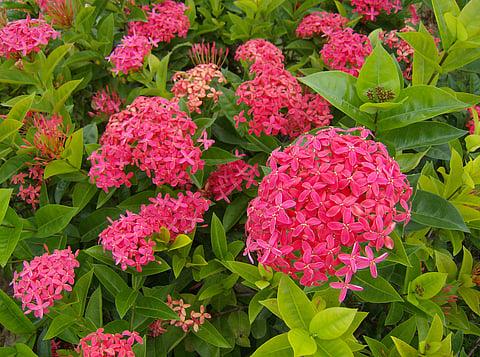

In India’s fast-growing urban landscapes, a beautifully designed hedge is one of the simplest ways to add structure, privacy, and visual appeal to any outdoor space. Unlike walls or metal fencing, hedges soften the space with greenery, guide the eye, reduce dust, and bring colour through seasonal blooms. Whether lining a driveway, outlining a garden bed, or creating a natural boundary between spaces, flowering hedges elevate the aesthetic of both homes and public landscapes.
At Garden Up, we recommend a set of reliable, sun-loving tropical hedge plants that perform consistently in Indian conditions: Ixora, Tecoma, Jasmines, Thorn roses, Euphorbia (Crown of Thorns), and Kaner (Oleander). These plants not only offer dense foliage but also produce vibrant flowers that enrich the overall design. Flowering hedge plants are perennial shrubs that can be planted in a line to form a green wall. They attract pollinators, remain evergreen, and when spaced correctly (about 1-1.5 feet apart), grow into a thick, uniform hedge within a few months. Their purpose is both functional and decorative — blocking unwanted views, guiding pathways, and adding a burst of colour to the landscape.

Sun requirements
All recommended hedge plants thrive in full tropical sun:
Ixora and Tecoma love 5-7 hours of direct sunlight and bloom best in open spaces.
Kaner and Euphorbia milii tolerate extreme heat, making them perfect for west-facing gardens.
Jasmines prefer bright sun but can manage light shade in the afternoon.
Thorn roses need abundant sun for vigorous flowering and dense foliage.
These species are ideal for Indian cities where summers are strong and most outdoor spaces receive harsh sunlight.
Soil requirements
The key to a long-lasting hedge is well-prepared soil.
General rule: Use well-draining soil enriched with compost.
Ixora prefers slightly acidic soil; adding cocopeat or leaf mould improves performance.
Tecoma, Kaner, and Jasmines are adaptable and grow even in mildly alkaline or sandy soils.
Euphorbia milii, being a succulent shrub, requires the fastest drainage — add sand or gravel to avoid soggy roots.
Thorn roses grow best in loamy soil with airflow around the roots.
A mix of red soil, compost, and sand works for most Indian landscapes.
Trimming and maintenance
A hedge looks neat only with regular trimming.
Trim every 6-8 weeks during the growing season.
Tecoma and Kaner can be pruned hard to keep them compact.
Ixora prefers gentle trimming; avoid heavy cuts before flowering cycles.
Jasmines should be pruned after flowering to promote new shoots.
Euphorbia milii must be trimmed sparingly and carefully — its milky sap can irritate skin.
Thorn roses need pruning to control height and remove dead wood.
Mulching and compost application every few months will maintain lush growth.
Starting from saplings
All these hedge plants grow easily from small 8-12 inch saplings, at a gap of 10”in zig-zag fashion.
Plant them 1-1.5 feet apart for a full hedge.
Water daily for the first 2-3 weeks; later shift to deep watering every 2-3 days.
Roses and jasmine benefit from a small stake initially.
Kaner and Euphorbia need less water once established.
With early care, the hedge typically thickens within 4-6 months.
Flower colour options
Ixora: Red, orange, yellow, pink, white
Tecoma: Yellow, orange, sometimes pink
Jasmines: White, off-white, light yellow in some types
Thorn roses: Red, pink, peach, yellow, white
Euphorbia milii: Red, pink, white, yellow, bi-colour
Kaner (Oleander): Pink, red, white, yellow, peach