
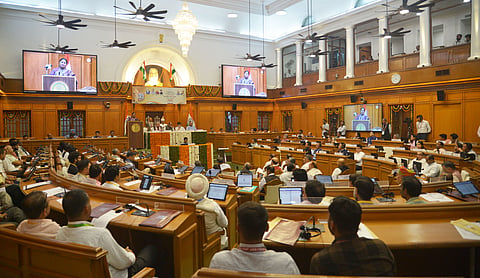
Bill for hefty penalty up to Rs 3 cr in place of jail likely in Delhi Assembly today
NEW DELHI: The cost of simplifying a law can be quite exacting. Escaping jail under the proposed Delhi Jan Vishwas (Amendment of Provisions) Bill 2026—which is likely to be tabled in the Delhi Assembly on Friday—will not mean going easy on offenders, as it swaps imprisonment for steep civil penalties that touch the sky, ranging from Rs 20 lakh to as high as Rs 3 crore in the most serious cases.
The proposed law seeks to decriminalise minor violations across several Delhi government laws and replace imprisonment with a structured civil penalty system. The draft bill could not be taken up in the ongoing Assembly session over the past two days due to early adjournments.
In the education sector, laws governing professional colleges and diploma-level technical institutions will scrap imprisonment clauses and impose stiff civil penalties of up to Rs 3 crore for violations, such as charging capitation fees.
Under the Delhi Industrial Development, Operation and Maintenance Act, 2010, unauthorised construction or alteration in an industrial estate will attract a civil penalty of up to Rs 25,000, with an additional Rs 1,000 per day if the violation continues. Misuse of industrial land may draw a penalty of up to Rs 10,000 plus `500 per day. Non-compliance with key provisions under the amended Section 40 can lead to penalties of Rs 10,000 to Rs 25,000, while other contraventions may now attract up to Rs 5,000, instead of the earlier token fines.
In the Delhi Shops and Establishments Act, 1954, major contraventions will attract a fine of Rs 10,000 to Rs 25,000, with higher amounts for continuing defaults. Under the Delhi Electricity Reform Act, 2000, civil penalties will now range from up to Rs 1 lakh and up to Rs 6,000 per day for continuing violations. Civil fines for serious breaches will range from from Rs 5 lakh to Rs 20 lakh.
Under the Delhi Agricultural Produce Marketing Act, 1998, civil penalties will be up to Rs 50,000 plus per-day charges.