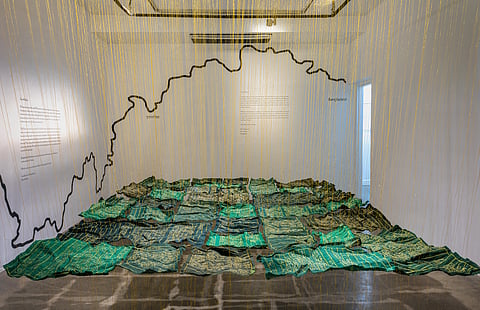

According to Bangladeshi artist Ashfika Rahman, the act of embroidering has long been the language of emotional expression for Bengalis. “Women historically stitched flowers, birds, and short lines of poetry or longing onto household textiles, as hidden and deeply personal messages,” she remarks, pointing to one of the installations in her solo exhibition currently open at Vadehra Art Gallery in Defence Colony till January 24.
The exhibition ‘Of Land, River, and Body (Mati, Nodi, Deho)’ includes three of Rahman’s ongoing projects — ‘Than Para: No Land Without Us’, ‘Files of the Disappeared’, and ‘Behula These Days’.
A large installation titled, ‘Letters to Behula’, part of ‘Behula These Days’, features 29 embroidered letters written by women living along riverbanks, addressed to the legendary heroine of Bengali folklore. These letters speak of domestic violence, displacement, religious conflict, state violence, climate disaster, loss, and survival. The giant artwork consisting of 29 distinct pieces of green fabric, embroidered together with golden thread, hangs in the centre of the room, forming a raft-like structure. The show overall focusses on gendered survival in south Asia.

Claiming land
Another major attraction of the show is ‘Than Para: No Land Without Us’, which addresses state-assisted land grabbing in the Chittagong Hill Tracts (CHT) of Bangladesh. The region, which borders India and Myanmar, is home to indigenous communities who continue to face forced displacement due to industrial development and luxury tourism. The installation features a large orb made of hundreds of suspended brass bells. Every bell is marked with a villager’s thumb impression in red kumkum.
The word ‘Than’ refers to land, home, and the name of a local deity, emphasising the community’s spiritual relationship with their territory. On the other hand, the thumbprints read like petitions, symbolising presence and belonging. The bells, which hold spiritual significance across Hindu, Buddhist, and Christian traditions, ring together with even the slightest breeze. According to Rahman, the collective ringing of these bells reverberates the villagers’ message that they are still there — they hold the rights to the land.
Open archive
Another key ongoing work, ‘Files of the Disappeared’, was started in 2018 by Rahman. It focuses on enforced disappearances and extrajudicial killings in Bangladesh. "When violence persists, the archive cannot be closed,” she says. The project as a visual record made for the future, “when truth may finally be allowed to surface.”
Artists serve as both witnesses and mirrors to society, particularly during periods of surveillance, repression, and turmoil. “In such conditions, art becomes a necessary space to reveal, resist, and reimagine,” she says, calling her practice a way to archive the present and build a collective voice connected to global solidarity. Rahman emphasises that the work is created in collaboration with others: “This work is not mine alone; it belongs to those whose lives shape it. I make work so disappearance is not the final word.”
Illuminated portraits are displayed in circular formations on distorted pedestals, each representing an individual wound carried by survivors of disappearance and imprisonment. The artist notes that the glow from the light boxes signals a refusal to disappear, asserting visibility through collective presence.
Alongside these portraits are landscape photographs of riverbanks, dense forests, and a road cutting through green fields. As told by Rahman, these are the sites where bodies of disappeared individuals were later found.
Bangladesh, at present, is in turmoil; the killing of Bangladeshi student leader Sharif Osman Hadi, for example, was a case of political vendetta. Rahman speaks against such violence, adding she further condemns attacks on newspapers and cultural sites during politically charged moments. Such actions create “a dangerous precedent towards intolerance of different voices and expressions in a society”, she adds. She stresses that culture, which evolves over millennia, is the responsibility of both politicians and civil society and threats to it should be handled with care.
Resisting erasure
Rahman’s art, which takes inspiration from the turmoils faced by marginalised communities in Bangladesh, is an approach she links to her childhood experiences observing her mother’s work as a social worker with indigenous and minority groups. “Her work shaped my ethical and emotional framework long before I became an artist,” the artist points out.
Rahman’s “archivism” rests on “lived testimony rather than institutional record” focussing on social realities that are difficult to capture through mainstream media,” Rahman tells TMS. “Rather than speaking about communities, I work with them, ensuring their words, gestures, and presence shape the work. This collective authorship allows the work to speak with integrity, care, and political weight, beyond my individual gaze.”