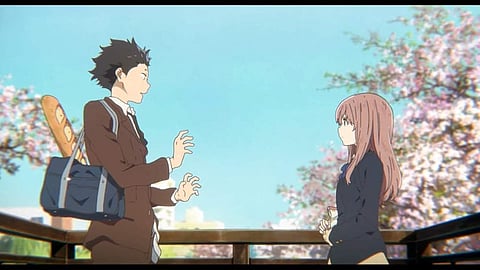

Nearly a decade after its release, the Japanese anime film A Silent Voice (Koe no Katachi) continues to be returned to, discussed, and deeply felt. Last week, its creator, mangaka Yoshitoki Ōima, made her first visit to India—travelling to Delhi for the New Delhi World Book Fair before appearing at the 19th Jaipur Literature Festival.
Born in 1989 in Japan’s Gifu Prefecture, Ōima belongs to a generation for whom manga was both entertainment and emotional language. Her mangas—A Silent Voice and To Your Eternity—need little introduction among manga and anime fans worldwide. Her journey as a manga artist began early, sparked by her brother’s collection—particularly Yuzo Takada’s 3×3 Eyes. She taught herself to draw, encouraged by friends who recognised her talent. “My friends kept telling me I could become a mangaka. Gradually, I made up my mind—and in a natural way, here I am.”
Before A Silent Voice, Ōima’s career took an unexpected turn with Mardock Scramble, her manga adaptation of Tow Ubukata’s cyberpunk novel—a violent dystopia marked by gambling dens, corruption, and bodily transformation. Its harsh, chaotic world could not be further removed from the quiet school corridors of A Silent Voice.

A Silent Voice went on to win the prestigious Tezuka Osamu Cultural Prize and was adapted into a globally successful anime film in 2016. Often reduced to a “manga about bullying”, Ōima—speaking through a translator—insisted this label misses the point. “Bullying and hearing impairment were never the main themes,” she said. Instead, the story centres on perspective—specifically that of Shoya, a former bully weighed down by guilt and contemplating suicide, rather than Shoko, the deaf girl he once hurt.
“It’s very easy to empathise with someone who is bullied,” Ōima explained. “But it’s very difficult to understand the person who bullied someone.” Shoya does not begin with the intention to harm. His actions stem from curiosity, carelessness, and social pressure—until, gradually, the outcome becomes cruelty. That uncomfortable process, she noted, is the story she wanted to tell.
Autobiographical notes
Many of the manga’s emotional foundations come from Ōima’s own life. She witnessed bullying at school, and her mother is a sign language interpreter—an influence that shaped the character of Shoko. Yet Ōima is also deeply invested in hope. Real life, she acknowledged, does not always offer redemption. Manga, for her, is a must. “I always need a happy ending,” she said. Survival, connection, and the possibility of making amends matter profoundly in her storytelling.
Communication—its failures and possibilities—also lies at the heart of A Silent Voice. “Even between hearing people, communication is difficult,” Ōima noted. “It’s not only that Shoko cannot convey her feelings to others. Hearing people also fail to convey their feelings to one another. There are so many gaps.”
Creative process
It is in silence that Ōima feels most at home. She spoke passionately about quiet panels—moments where nothing overtly happens, yet everything is felt. These pauses, she believes, are the most important parts of her work. Conveying silence in manga is difficult; it requires careful visual “rules,” recurring motifs, and, above all, trust in the reader.
When asked about her creative process, Ōima described it as something that arrives “all together”—images, words, and emotions forming simultaneously. She keeps extensive notes, sometimes for plot points that will surface only a year later, ensuring nothing essential is lost. Visual ideas, she said, often arrive unexpectedly, while doing something mundane like cooking or washing her hands.
She also described embedding subtle signs—almost secret markers—throughout her work, guiding readers toward meaning without spelling it out. “I don’t say anything,” she explained. “But this is what I’m saying. And the reader has to understand.”