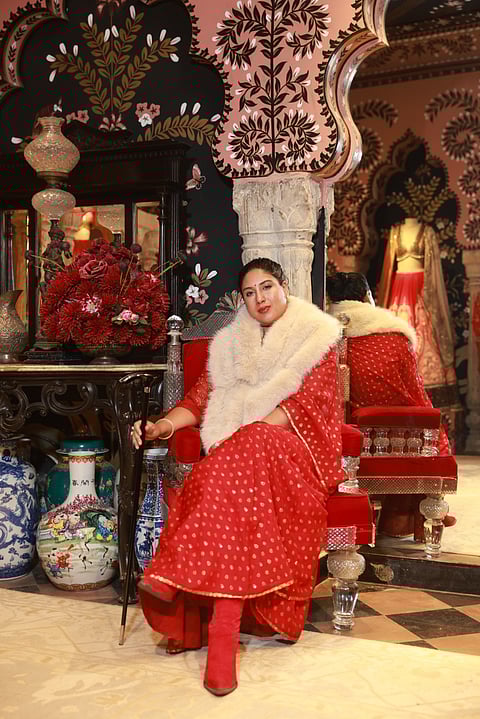

In a city shaped by speed, reinvention, and spectacle, Marwar Jodhpore has expanded cautiously. One year into its Delhi flagship, the house has grown its footprint while resisting rapid scale, an approach that slows production and limits how quickly new collections can enter the market.
The tone is set at the entrance itself. It operates as a gateway to another time. Fountains mark the threshold, tiered mannequins stand in quiet formation, and Hindustani classical vocals drift through the evening air. Turbaned attendants move through the space with food, reinforcing the impression of a palace rather than a store. Flowers, camphor, and layered décor engage the senses, slowing visitors before they step inside.
The private anniversary gathering drew patrons and members of India’s former royal families, including Radhikaraje Gaekwad, Maharani of Baroda—reflecting how royal associations still function as cultural capital within Indian luxury.
Founded and led by ArchiRaj Keyal, Marwar Jodhpore has long resisted the churn of contemporary luxury. Keyal’s background in defence manufacturing informs the house’s culture of structure, discipline, and long-term responsibility.
Palace recall
Fashion here is not seasonal impulse but institution-building. That discipline, however, also limits how quickly the house can scale in a market built on speed. The expanded flagship rejects conventional retail design, drawing instead from noble residences. Spaces unfold through quiet procession—checkerboard stone floors, cusped arches, painted ceilings, and layered corridors referencing Rajput and Marwari traditions. Without spectacle or haste, the layout slows movement, inviting a palace-like walk rather than a shopping circuit.
The interiors rely on natural stone and hand-finished materials that are meant to wear in, not be replaced, reflecting an approach that values longevity over visual novelty.
Movement through the store avoids linear retail logic. Entry, pause, and reveal form a deliberate rhythm. Lehengas stand aligned like sentinels, seating resembles a royal diwan, and a central fountain anchors the space with stillness. The experience is ceremonial rather than transactional.
The language of gota
This commitment to continuity extends beyond architecture into the lives that sustain the craft. Much of Marwar Jodhpore’s textile language—particularly its gota work—is preserved through an NGO founded by Keyal’s mother.
The initiative ensures artisans are employed year-round and paid fairly, allowing both livelihood and knowledge to endure. “Maintaining year-round employment”, Keyal admits, “is costly and limits how quickly new collections can be produced. The idea was never to extract a craft for a collection and move on. If the people who carry the knowledge cannot sustain themselves through the year, the craft itself collapses.”
Fabric of lineage
The bridal lehengas and suits reflect the same resistance to haste. Benarasi textiles form the backbone of many ensembles, with a single bridal suit taking three to four months to complete. Each piece is tailored closely to the wearer, built through layered handwork rather than assembly-line efficiency. Fabrics are sourced from south India and Kashmir, chosen for lineage and integrity rather than trend alignment.
“At Marwar Jodhpore, one year is not measured in time, but in patience learned and responsibility earned,” Keyal reflects. “Anything built to last demands discipline and continuity.”
To commemorate the anniversary, the house unveiled The Seven Courtyards: A Year Carved in Heritage, a collection structured as seven symbolic chambers tracing its inaugural year in Delhi. The metallic tones are muted rather than glossy, the silhouettes restrained, and the garments are intended to be worn across generations.
Delhi, with its layered history and understanding of ceremony and restraint, offers a natural context for this evolution. In an industry obsessed with the new, Marwar Jodhpore continues to build for time—where architecture, couture, and heritage exist in quiet alignment.