
Growing up, I remember my mother being utterly taken in by the kitchen of the early nineties. It was her private theatre of experimentation, stocked with everything she learnt at the famous Mrs Babbar’s cooking classes in Dehradun. The said Mrs Babbar was something of a culinary oracle in the town. At some point, she had probably taught most women how to make pineapples look decorative, chicken Continental, and how to host with what felt like European flair.
My mother kept maroon leather-bound diaries where she wrote her recipes in steady cursive. Sometimes she added little notes in the margins; sometimes she marked a recipe with a triumphant tick. I was fascinated by those diaries, dreaming of the day I would inherit them and make pastry that held its shape or puddings that trembled slightly when you tapped the plate. That day came quietly. The diaries now sit on my shelf and open as easily as memory itself.
These recipe diaries feel rare now, slowly crowded out by YouTube tutorials and algorithmic reels that promise speed, clarity and supermarket-friendly substitutions. Useful, certainly, but they lack the tactile charm of a page that has been cooked upon. The faint smudge of cinnamon. A ring left by a hot bowl. The scent of vanilla and impatience and Sunday afternoons. A diary like that holds its own kind of gossip.

A few weeks ago, in the leafy folds of Safdarjung Enclave, I found myself at a supper club that made me think of those maroon diaries again. It did not belong to any single region’s cuisine. Instead, it drew from the personal archive of Mr Khaitan, a man who cooks through his travels and feeds his family on recipes that roam easily between India and the world. His daughter, Sreeparna Khaitan, and Surbhi Anand have now gathered these recipes into a book called Bapu’s Curries. The supper was hosted in their cosy home, the sort of space where the smell of caramelising onions can wander into the living room and join in on the conversation.
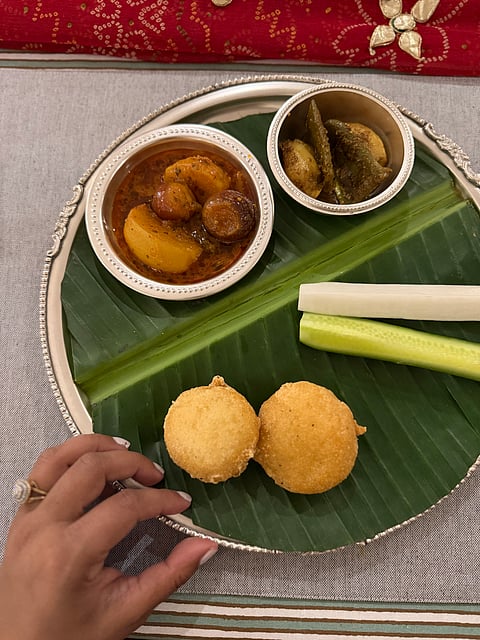
We ate Hara Chana Nimona masquerading as a chaat, an onion broth with mushroom melange that nodded politely towards Japan, and Dal ke fulaure with coconut cream sauce and panta bhaat. There was shalgam gogji with potato and green bean pickle from Benaras served alongside dhuska from Jharkhand. It was quietly disarming food. Supple with memory but never weighed down by it. The Khaitan sisters cooked as if they were letting us leaf through the pages of their own family album. Between dishes you could sense the presence of their father in the way the flavours lingered and refused to be hurried.
It struck me that recipe preservation is not always about glossy coffee-table books or museum-style archiving. Sometimes it is about family ritual and the wish to keep flavours moving forward rather than locked away. By compiling Bapu’s Curries and hosting these intimate pop-ups, the sisters have allowed Delhi to encounter dishes that once lived only in their kitchen. Dishes gathered from hotel buffets, holiday kitchens and market stalls, and then made permanent in the rhythms of home.
Holding my bowl that night, I thought of my mother’s maroon diaries and how they have made their quiet journey from her shelf to mine. I thought of how recipes travel. How they change hands without losing their character. How they gather new admirers in cities that did not originally birth them. In their own way, the Khaitan sisters are doing what my mother once did and what I now try to do. They are stitching together appetite and memory, inviting others to sit at the table and taste a life that is still being lived.
And perhaps that is the real point. The diaries have not vanished. They have simply multiplied. Some arrive leather bound. Some arrive spiral bound. Some arrive as pop up suppers in green neighbourhoods. But in every case the past sits at the table without ceremony, served warm and without fuss, waiting for someone to take the first spoonful.