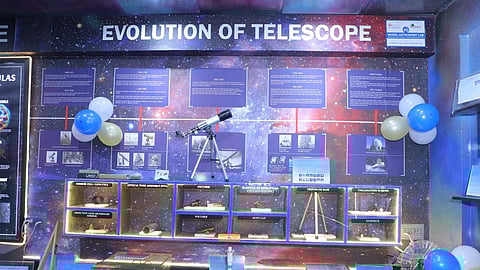

NEW DELHI: Until recently, the science classroom at Government Girls Senior Secondary School No. 3 in Badarpur resembled a typical government school laboratory, with charts on the walls, worn textbooks on desks, and a few basic instruments providing a semblance of a science learning space.
However, with the introduction of a model astronomy laboratory, the ordinary classroom has been transformed into what educators describe as a “window to the cosmos.” The lab has been established with support from the Aahwahan Foundation.
Detailed models of the solar system, satellites, rockets, galaxies, and other celestial bodies now surround students, turning abstract scientific concepts into tangible learning experiences. Instead of memorising facts, students can now explore them by tracking planetary motion, understanding eclipses, and visualising the formation of stars and galaxies. The immersive setup has significantly changed classroom dynamics, encouraging curiosity and engagement among students who earlier found science intimidating.
According to UDISE data for 2024–25, out of 2,225 schools, 2,167 have science laboratories, but a majority lack adequate infrastructure and proper scientific instruments to support experiential learning.
Reacting to the initiative, a teacher at the school said the impact of the astronomy lab extends far beyond the addition of new equipment. “We have observed a noticeable shift in classroom energy. The hands-on approach invites observation, inquiry, and critical thinking, fostering a scientific temperament and clearer conceptual understanding,” she said.
Teachers have also noted increased student participation. Pupils who earlier hesitated to speak now ask questions confidently, while science periods are eagerly anticipated rather than hurried through.
Students say the lab has made learning exciting and accessible, creating an environment where curiosity is encouraged rather than suppressed.
Founder of the Aahwahan Foundation, Braja Kishore, said the lab represents opportunity, particularly for first-generation learners. “It challenges the assumption that advanced science education belongs only to elite institutions. Seeing satellites and space missions up close sparks conversations about careers in science, engineering, and research that once felt unreachable,” he said.