
With winter, the Delhi air turns cold and acrid. Hospitals begin to fill with patients struggling to breathe. Doctors report spikes in respiratory failure, strokes and heart attacks, especially among the elderly.
Behind the scenes, another sector quietly prepares for the season: funeral services. For coffin makers, gravediggers and funeral directors, winters are when business peaks.
In Civil Lines and central Delhi, branded funeral homes say their phones start ringing the moment winter sets in.
“At the first dip in temperature and rise in pollution, calls don’t stop, many old people succumb to the cold, seeing a rise in the number of deaths ,” says Vinitha Massey, director of Massey Funeral Services in Civil Lines. Families want everything arranged quickly — transport, rituals and paperwork. “We provide everything under one roof,” she says. “Refrigerated ambulances, flowers, priests, memorial programmes.”
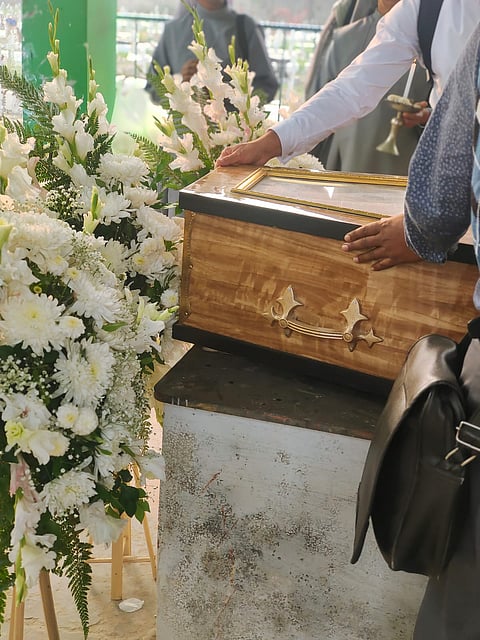
Most clients are middle-class families, many from Christian communities. The company also makes its own coffins, with the wood mainly sourced from Gujrat’s Jamnagar due to the availability of cheap wood in various grades and quality. The coffins are made using pine and teak in their basement workshop, with each coffin taking around six hours to assemble.
Prices vary sharply. Pine models range between ₹5,000 and 9,000—top-end prices depend on the grade of pine wood, the quality of finish and fittings and customisations tailored to family specifications. Teak coffins are around ₹15,000. Fibre-reinforced plastic caskets - lighter and cheaper - are now the bestseller. “Families prefer something affordable and easy to carry,” Massey says. The company also waives charges for newborn deaths.
The company sells bundled packages. A basic service, including hearse, ceremonial draping and grave arrangements, starts around ₹50,000. Premium packages with floral décor and obituary notices can cross ₹1–1.5 lakh.
Paying the bills
“We just wanted everything done respectfully,” says Maria Fernandes, 52,a customer at the funeral home, whose father died last month. “They [Massey] handled the ambulance, flowers, even the choir. Only later did we realise the bill was over ₹1 lakh. At that time, you’re not thinking about money.”
Massey says grief has also changed since the pandemic. Ceremonies are shorter. Families often seem rushed. “People don’t grieve the loss of their loved ones like they used to,” she says. “They want to finish off the formalities and leave the place.”
Working through the night
Several kilometres away in Paharganj, the supply chain looks very different.
Inside a narrow, unheated workshop, 58-year-old Ram Kishore smooths the edge of a wooden coffin. Sawdust covers the floor. Planks lean against the walls. He has been building coffins since childhood, a trade passed down from his grandfather.
He sells a basic pine coffin for ₹2,500–₹3,500, mostly to neighbourhood families and funeral homes that resell them at higher prices. “Earlier families came to us directly,” he says. “Now the big parlours buy in bulk.”
Winter means back-to-back orders. Calls come late at night; coffins must be ready by morning. Kishore and his two apprentices often work without breaks.
“Death doesn’t wait,” he says, without looking up.
But earnings haven’t kept pace with costs. Wood prices have doubled in recent years, he says, while wages remain low. Workers are paid per piece, with no contracts or benefits.
Sunita Devi, 35, who sands and fits handles, says she sometimes works until dawn. “We add drapery and handles for ₹500 extra,” she says. “If we don’t finish, the van keeps calling.”
“As this is largely an informal economy, workers like us do not have contracts or benefits,” says Kishore while rubbing glue from his cracked fingers. “For us it’s just work,” he says. “For families, it’s the last thing they touch. That responsibility stays with you.”
‘Not much time to mourn’
The seasonal surge cuts across communities.
At Old Delhi’s Jadid Qabristan, one of the city’s oldest Muslim cemeteries, gravedigger Mohammad Shameem says burials increase sharply in winter. Islamic tradition requires burial within 24 hours, leaving little time for delay.
“In summer we might have five or six a week,” he says. “In winter it can double.”
Bodies are washed and wrapped in a simple white shroud (kafan), then carried on wooden biers to the graveyard. Usually no coffins are used. “All are equal in death. Just a cloth and a grave is what’s needed.”
Even so, families spend small amounts on tools, lighting or cloth. Volunteers often step in to cover costs for the poor. “Sometimes it’s only ₹300,” says Saleem Khan, who helps with burials. “We try not to charge anything.”
The graves are usually 6 feet in length, require 3 hrs to dig and must be ready by dawn. The cold and frozen soil makes digging harder.
“It’s fast,” Khan says. “We pray, we bury, we move to the next. There isn’t much time to mourn.”
A quiet seasonal economy
Together, these parallel worlds form an unseen winter economy, one tied closely to the city’s toxic air.
As the cold and pollution rises, so do orders for coffins, hearses and graves. Yet the burden falls unevenly: grieving families pay steep bills, while informal workers labour through the night for modest wages.
By evening at Massey Funerals, another van pulls in. A fresh coffin is unloaded and carried inside. Across the city, Shameem digs under a dim torchlight, preparing the next plot.
While winter sees the slowdown of businesses, for funeral workers the winter never sleeps.