
The entry point to a city is the gateway to creating a perception about the city’s makeup. Delhi is unfortunate in this matter. While the medieval and colonial rulers built appropriate gates to the fort cities, the same has not happened in 21st century Delhi.
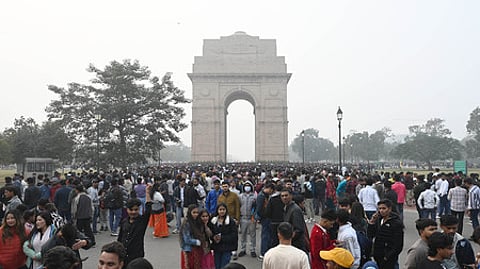
While the walled city from the Mughal era is replete with structures like the Delhi Gate, Kashmere Gate, Mori Gate, Lahori Gate and Turkman Gate, the British also built the War Memorial (India Gate) hexagon at the outskirts of their regal city.
The capital city of medieval era could only be accessed by road. During the British rule, the railways and airway were introduced. The British also built imposing structures like Delhi Junction (Old Delhi) and the New Delhi stations.
The unplanned expansion of the city in the 21st century has, however, stolen from it the grandeur of the entry point. With the city now expanding into three states (the National Capital Region), there are multiple entry points. The railway stations too have now become part of densely populated localities.The airport, although still in the outskirts of the city, has all of its roads choc-o-bloc full. Thus there is no smooth entry to the capital city.
This situation was best illustrated in the observations at the meeting of the Commission for Air Quality Maintenance (CAQM). The commission flagged congestion at MCD toll plazas as a significant concern, stressing the need for urgent rollout of barrier-free tolling systems to curb vehicular emissions in Delhi-NCR.
The commission went on to highlight the need for expeditious implementation of barrier-free-multi-lane free flow systems integrated with RFID and Automatic Number Plate Recognition technologies to ease traffic snarls and reduce pollution. While the measures are appreciated, the roads reaching the airport from the city, and the traffic jams outside the railway stations need to be addressed. This, the Commission should realise, adds as much to vehicular pollution as the jams on the entry points to the city.
In the discipline of town-planning, Gateway Congestion is described as a land-use problem, which is often confused as a traffic problem. Dense commercialisation around stations without proportional mobility planning inevitably has overwhelmed roads. Transit-oriented development principles must include traffic absorption capacity, pedestrianisation, and structured access design. This is something most visible in the case of the three major railway stations of Delhi – Old Delhi, New Delhi and Hazrat Nizamuddin.
In the case of the airport too, while the aero city is well planned, the bottleneck of Mahipalpur is overpowering. The airport cannot be accessed without getting stuck on the road passing though the now fully urbanised village.
Delhi’s expansion across state boundaries complicates solutions. Fragmented governance produces fragmented traffic outcomes. A commuter travelling from Gurugram to Central Delhi, or Noida to the airport, crosses several administrative jurisdictions. Road planning is done by different agencies. Traffic enforcement is handled by separate police forces. Public transport systems are governed by different entities. Traffic flows, signal timing, parking, and incident management are rarely unified. No single institution has the authority to optimise the entire journey.
India, in its search for a place in the pantheon of developed nations, certainly need to have the roads of its Capital city and the adjoining regions free of congestion. This could save the country of embarrassment, like when a delegation of senior bureaucrats from several developing countries were forced to walk to the Mini Secretariat in Gurgaon after their bus was caught in traffic.
A metropolitan-scale mobility authority with operational control over corridor planning, traffic data integration, and enforcement coordination could address systemic inefficiencies. Such an authority will not replace existing bodies but coordinate, integrate, and optimise across them.