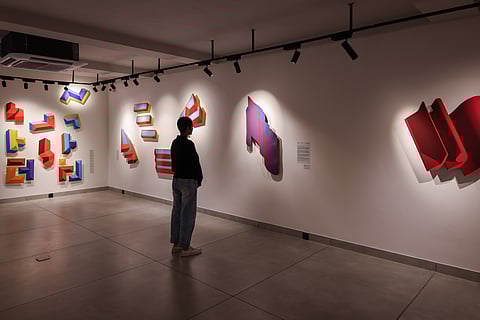

Every year, Delhi’s art scene comes alive with the India Art Fair, new exhibitions, and gallery openings, the city turns into a network of viewing, gathering, and exchange. But the question is no longer only about what is being shown, but where and how. What does it mean to hold space for art works that speak volumes — to its viewers as much as to its artists?
Among the newly opened galleries is Gallery XXL on a busy south Delhi colony. Established by the same founders as St+art India Foundation, Arjun Bahl, the late Hanif Kureshi, Giulia Ambrogi, and Thanish Thomas is well known for its public art interventions and projects across India. Gallery XXL is part of the emerging Defence Colony art district, which includes 12 other galleries. The location was chosen for its growing art ecosystem and its proximity to the Lodhi Art District. “We wanted to be part of the art district,” says Sarah Malik, curator at the gallery. “Like Mumbai’s Art Night Thursdays, we’re now working towards Art Night Fridays in Delhi.”
In the same locality, gallery Latitude 28 has opened its second viewing space — inside a red-brick building distinct on the street, an extension of gallerist Bhavana Kakkar’s long-running gallery, whose flagship remains in Lado Sarai.

Reflecting on the choice of location, Kakkar points to a shift in audience behaviour after the pandemic. “Before COVID-19, Lado Sarai was a real hub,” she says. “But post-COVID-19, people became used to staying within their own areas. The footfall was reduced.” She was also keen on retaining audiences from neighbouring regions. “We still get a lot of visitors from Gurugram — interior designers, architects, and collectors. That’s why I kept the viewing room at Lado Sarai — I didn’t want to lose that demographic.”
Designer Tushant Bansal, who worked on the gallery, says the core idea for the Defence Colony space came from marine navigation. “We were inspired by how ships use latitudes to navigate. I loved that sense of direction and exploration,” he says. Drawing from ship and vessel interiors, the design incorporates aluminium doors and converging windows, with subtle Art Deco influences.
At Gallery XXL, colour is also part of curatorial strategy. For a recent exhibition by Berlin-based artist Jumu, the walls were painted deep blue, evoking dawn, memory, and Latin American markets from her paintings. “It’s about creating an environment,” Malik says, “not just hanging work on white walls.”
Designing for flexibility
One of the biggest challenges for Delhi galleries is spatial constraint. Lower ceilings, narrow plots, and compact viewing areas often limit architectural ambition. “At our Mumbai space, we had 14-foot ceilings,” Malik recalls. “Here, the height is lower, and that does limit some of the XXL-scale works our artists like to make.”
Many of the artists represented by Gallery XXL come from street art practices, often creating life-sized works in public spaces. “We’re always thinking about how the influences of the street enters the studio and how the studio practice shift the work in the street,” Malik adds.
The Delhi space was built in just three weeks, with in-house designers working alongside the founders. On the second level of a newly constructed building, the space has been designed to be modular and adaptable with movable panels, split walls, and swing partition. “When we curate, we think about the viewer’s journey. The walls and panels help us build that spatial narrative,” adds Malik.
At Latitude 28, Bansal worked around low ceilings by blurring boundaries between floors, walls, and ceilings. “We used white everywhere to make the space feel larger,” he says.
While galleries are often perceived as neutral spaces, Bansal explains that a distinct personality can still be maintained. “We wanted to add energy and playfulness. It can’t just be white floor, white wall, and white ceiling.” he says. Subtle red accents were introduced to break the monochrome palette, with wheeled partitions that break the monotony of how viewers walked around the viewing rooms.
The gallery opened in November, with the inaugural exhibition ‘Dramaturgies of Space’, which views the “gallery not as a container for art, but a stage where meaning is continuously produced”. Artist Juhikadevi Bhanjdeo who was one among the exhibited artists believes spatial limitations can become creatively productive. “Once you know the boundaries, they stop being restrictions. They become a playground,” she says. “Work stands differently when space is different. It’s a conversation between work, space, and people.”
In a city like Delhi, climate control is crucial. Humidity, temperature, and moisture can severely damage artworks if left unmanaged. While newer buildings offer better insulation and waterproofing, older structures often require costly retrofitting.
“Services are the hardest part,” says Bansal. “When it comes to plumbing lines, you really can’t change much. Sunken areas remain sunken. Toilets and pantries have to stay where they are. In existing spaces, these services have to be respected.”
Breaking the white cube
For decades, galleries followed the ‘white cube’ model — neutral walls, lighting, and minimal distraction. While this remains influential, many spaces are now modifying the formula.
At the newly opened Anant Art, gallerist Mamta Singhania talks about the psychological impact of space. “Architecture affects how people perceive art. We work with architects who understand this,” she says. Studio Lotus, which designed Anant Art’s second space in Safdarjung, approached it as a “white unfolding canvas”. Co-founding principal Ankur Choksi describes it as “a paper-like envelope” that allows visitors moments of pause and discovery.
The gallery has worked out of a few locations in the past, most recently out of Noida which Singhania notes was a large gallery space “where we have had voluminous exhibitions”. “It was important for us to have a space in Delhi. Also to accommodate collateral programming be it a performance art piece or a film screening to go along with our exhibitions,” she adds.
At the gallery, lighting remains central with natural light has been utilised as an ambient fill. “For an art gallery, the artificial lighting is the primary light source, which allows for a very controlled curation and rendering of light,” adds Choksi. The multi-level gallery unfolds vertically around a 60-foot-tall sky-lit central courtyard, allowing light to filter through multiple levels. Sliver-like openings cut street noise while maintaining a sense of openness.
Today, a ‘good’ gallery is no longer just about white walls and artworks on display. “The space itself becomes part of the artwork," says Bansal. At the same time, a gallery must remain open and inviting. “The space should not feel forbidding,” Malik says. “Visitors should feel welcome, be loud, and talk about art. Like in this exhibition, experience joy and collective memory.”