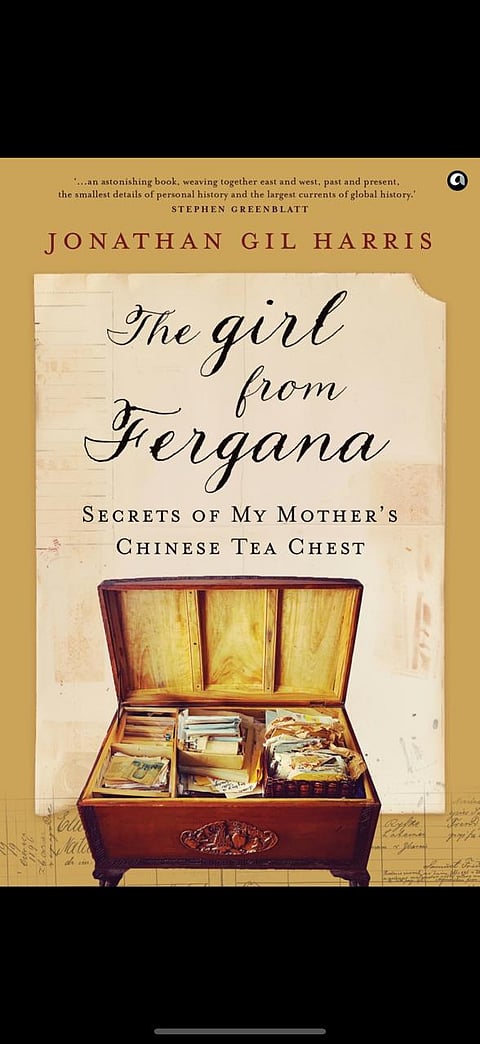

Growing up in New Zealand, author and academic Jonathan Gil Harris was always fascinated by the tea chest that sat unopened in his hallway for decades; a wooden trunk that had travelled from Warsaw to the Fergana valley in Uzbekistan to Palestine and then to Auckland. Inside were letters, photographs and fragments of a vanished world. When he finally opened it, his mother was losing her own archive to Alzheimer’s.
“It was like a hard drive of memories,” he recalls. As her English faded, she returned to Polish and Hebrew, her childhood languages, and, unexpectedly, to bursts of Uzbek, the language she picked up in Fergana.
“She spoke in Uzbek bursts,” he says. Words like mushkil, aasan, kabristan, familiar to Hindi and Urdu speakers startled him. When Harris moved to India in 2011, he discovered how entrenched Central Asian languages were in the subcontinent. “I learnt that Hindi and Urdu are related to Uzbek. It delighted me. It was as if her past had found a new home in my present.”
Completed in 2024 and released in 2026, The Girl from Fergana published by Aleph, is what Harris calls his “most closest book" . The memoir is at once a son’s elegy, a historian’s excavation, and a lament for a world fractured by modern nation-states.
A tale begun long ago
At its heart is Harris’s mother, Stella, born into a Jewish family in Warsaw, fleeing the city in 1939 from the Nazis; from Poland, she went eastward to Siberia and eventually landed up in Fergana, central Asia spending five formative years of her life between 1941 to 1946. “It takes a village to raise a child,” Harris says, “but it also takes centuries to explain the origins of a person.” To tell one person’s story, he insists, “you need to go hundreds, even thousands of years back to understand the ripple effects that occurred to produce that life.”
Fergana, today divided between Uzbekistan, Kyrgyzstan and Tajikistan, was once the beating heart of the Silk Roads, the vast trade networks linking China, India and Persia. Long before passports and borders, it was a crossroads where Greeks, Persians, Jews and Indians lived together. “When we look at any place as a crossroads,” Harris says, “where people of different backgrounds meet, we get a different view of history -- a history beyond borders.”
After finding refuge in Fergan, she developed a lifelong friendship with Kamra Khan, an Uzbek girl. “Jews and Muslims lived together for centuries before the demands of ethnic nations made us believe the opposite,” Harris says. “Fergana was a reminder of that intimacy.”

Finding India
If Fergana was his mother’s emotional homeland, India became his historical mirror. Harris, found India's diversity reminiscent of the Silk Roads. “India is like a thali,” he says. “With incredible diversity.” But he also notes, with concern, a tightening emphasis on “one nation, one language, one religion.” For a historian, this narrowing feels like an impoverishment of imagination.
The book also speaks about issues like Zionism. “My mother was a Zionist. I am not,” he says. The disagreements between mother and son on Zionism are rendered tenderly, without rancour. “It’s written in a loving way,” he says. “Love is cherishing the imperfections.”
After the war ended in 1945, his mother was sent back to Poland by the Soviets. An uncle in Palestine found her and her sister, bringing them to what would become Israel. She lived there until 1958, later moving to England where she met the author’s father, then moved to New Zealand
Holding on to his mother
Yet Fergana remained the emotional axis.“She was loved deeply there,” Harris says. “That love went beyond community.” It shaped her capacity for generosity; a generosity that endured even in frailty. One of her final words to him, spoken in Polish after a fall that broke her hip, were: “You are so lovely.”
He had wanted to write about her since 2012, when Alzheimer’s began to erase her memories. “I couldn’t watch it,” he admits. The book took 15 years of gestation and six years of writing, rewritten several times, including after her death. “It was the hardest book I’ve written,” he says. “I didn’t want to stop, because while I was writing, she was alive in a way.”
The Girl from Fergana is many things at once: memoir, history, lament, love letter. It mourns an age when diversity was a norm rather than contested. It challenges the idea that Jews and Muslims are destined enemies. It asks whether a history beyond borders is possible.
Most of all, it is a son’s attempt to hold on.“This book helped me mourn my mother,” Harris says quietly. “And to see her from a place of love rather than anger or resentment.”
In telling her story, he resurrects a world where traders, monks, merchants and exiles shaped one another across continents, where a Polish Jewish girl could grow up speaking Uzbek, and where love outlived the nations that tried to contain it