
The cassette deck clicks, and the timeless voice of Mukesh fills the cramped cabin. Raja Kumar, 58, with his weathered hands taps the steering wheel… glances at his co-driver Satnam Singh. "Satnam Singh aur Mukesh mere saathi hain," he says with a grin. After 36 years on the road, the legendary singer feels like family, perhaps more present than his actual kin.
This cabin is the command centre of India's supply chain. While the nation sleeps, men like Kumar keep the economy breathing, hauling cargo across long distances. They are the invisible arteries of commerce, yet their lives remain largely confined within their trucks and the depots they frequent. Inside these cabins, drivers craft entire worlds to survive the solitude, curating leisure rituals that define their existence from one destination to the next
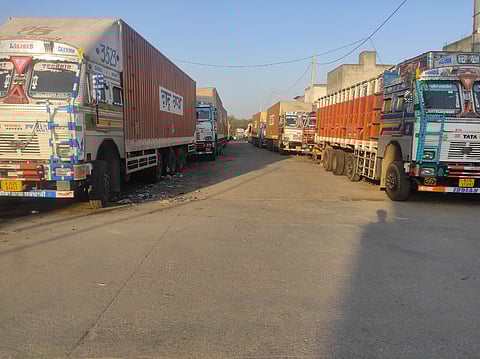
At Sanjay Gandhi Transport Nagar, 2,000 to 2,500 trucks create a city within a city, the evening ritual begins. Trucks line the roadside, as drivers gather in a circle sipping chai, bantering with each other and smoking beedis, a brief respite before the gruelling miles ahead.
A Bachchan-Hotstar routine
Kumar works for HPR Transports, a major freight company transporting textiles, industrial raw materials such as steel and cements, and metal sheets. He mainly drives along the NH-44, connecting Delhi and Bengaluru, a journey that takes about ten days for a round trip and is paid ₹20,000-25,000 per trip .To pass time, Kumar watches Amitabh Bachchan films like Don and Zanjeer .These days, he also streams Hindi serials on Hotstar. " When you watch films," he explains, "for two hours, you're not on NH-44. You're somewhere else. The highway dhabas become his companions. In the morning he drives; at night, his co-driver takes over. Even so, the road can get lonely.
A few trucks down, Sameer Muhammad’s, 55, cabin hums with a different kind of energy. With 24 years behind the wheel, he works for DTDC Express Ltd, navigating the bustling Delhi–Mumbai corridor. He earns ₹25,000 per round trip, threading through one of India’s busiest economic zones.
Songs lift mental strain
From his cabin, the timeless voice of Mohammed Rafi drifts softly. “Rafi sahab ki awaaz mein sukoon hai,” Muhammad says.When fatigue sets in, he lowers the volume, draws the curtains, lets the lyrics anchor him, and slips into sleep.
For 28-year-old Ajeet Yadav, who has been driving for the past five years on the treacherous Delhi–Shimla route, the mental strain is just as demanding as the physical. “One wrong turn and you’re gone,” he says. Entertainment on these roads is now digital and diverse, he keeps himself entertained with Haryanvi rap songs like Masoom Sharma and watches the latest Bollywood films, with Dhurandhaar the latest one.
The small rituals that fill the long hours on the highway are not mere leisure, they are survival mechanisms. For many drivers, family life unfolds hundreds of kilometres away. Kumar’s family - a wife and two sons - live in a village in Uttar Pradesh. Every evening, regardless of his schedule he calls them and finds solace in talking with his family. He sends them money every month. When work allows, he makes the journey back to the village.
For these drivers, the road itself becomes family. The dhabas, the long highways and fellow drivers are their constant companions. Music, films, and companionship with fellow drivers become bridges across that chasm.
Missing the partner
Yadav says he misses the easy camaraderie of friends back in his village and misses his girlfriend back in Banswara, Rajasthan, especially on the winding mountain roads where the silence feels heavier.
Muhammad, meanwhile, thinks often of his wife and children waiting in Aligarh. “This is the only life I know,” he says quietly. “I can’t imagine doing anything else. The loneliness, the distance from our families, that’s the price we pay for being in this profession.”
“Years behind the wheel take a toll,” says Kumar. “Chronic back pain, knee problems, stiff fingers… and the long stretches of solitude gives way to loneliness and depression. On top of that, every state border takes ₹800–1,200 in unofficial taxes. That’s money we could use for some comfort, but it just disappears into the system’s cracks.”
Sounds of survival
The generational divide is apparent. Kumar and Muhammad represent a slower, more yesteryear India, where songs of longing mirror their own measured pace. Younger drivers like Yadav, in contrast, gravitate toward the high-octane energy of Bollywood. Yet inside the cabin, they are men bound by the same resolve and ambition.
As night falls over Transport Nagar, engines roar to life and headlights slice through the dark as the drivers disband from their groups and go to their respective trucks, packing parathas for the long road ahead. Raja climbs into his truck, another Bengaluru run waiting. He slides in a cassette and the familiar voice fills the cabin. For the next ten days, Mukesh and his co-driver will be his companions along the long and interminable highway stretches.
On India's highways, loneliness travels at 60 kilometers per hour, but so does resilience, soundtracked by old classics, rap songs and the promise of the next delivery.