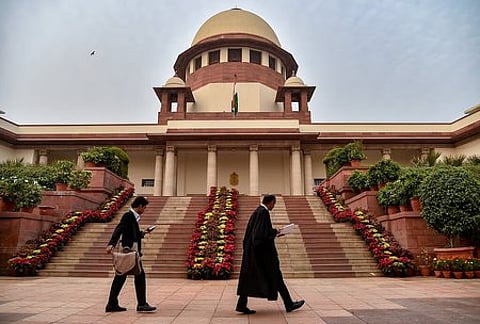

NEW DELHI: In the wake of recent rape incidents in Delhi NCR, the Supreme Court has directed the Delhi Police to strengthen beat patrolling around educational institutions and ensure strict verification of drivers and helpers of public transport vehicles.
The suo motu case was registered by the apex court following reports of recent rape incidents in the region.
A two-judge Bench headed by Justice J B Pardiwala and comprising Justice K Vinod Chandran issued a series of directions in the suo motu case titled ‘In Re: Recent rape incidents in Delhi NCR’. The court directed the Delhi government to file a compliance affidavit and posted the matter for further hearing on November 16.
The order was passed on October 5 and uploaded on the Supreme Court website on Thursday.
The Bench directed that beat patrolling be strengthened, particularly around schools, colleges and coaching centres, where young girls may be vulnerable. It said police presence should be visible and regular, especially during early morning and evening hours when students commute to and from educational institutions.
The court also directed strict verification of drivers and helpers of public transport vehicles, including buses, auto-rickshaws and e-rickshaws, to prevent criminals from entering the transport system and misusing access to commuters.
The Bench directed the Delhi Police and city authorities to identify unauthorised liquor shops and establishments operating without requisite permissions and take action against them in accordance with law, including sealing them where necessary.
The court also directed that the modules prescribed for the specialised training programme for Shishtachar Squads be placed on record. It said the Research and Development Branch of the Delhi Police should assess the existing training module, including whether it adequately equips personnel for preventive intervention, identification of vulnerable situations and effective engagement with victims, witnesses and the public.
The Bench expressed serious concern over the recent sexual assault incidents and said preventive policing was key to ensuring the safety of women and children.
The court, however, cautioned that preventive policing should not become a justification for arbitrary or disproportionate exercise of police powers.
"At this stage, we also deem it necessary to emphasise that the pursuit of preventive policing cannot become a justification for arbitrary or excessive or disproportionate exercise of police powers. The police must act firmly where the law requires intervention, but such intervention must remain within the bounds of legality, proportionality and accountability. Accountability is integral to effective policing and governance, for the citizens' faith in the system must be gained through effective enforcement, especially when the system is challenged, as is the case with the recent turn of events. A system which seeks to inspire confidence in citizens must necessarily be one in which citizens are protected not only from crime, but equally from unlawful or disproportionate exercise," the apex court said in its 25-page order.
The court also issued notice to the Union Ministry of Home Affairs and the Delhi Transport Department.
