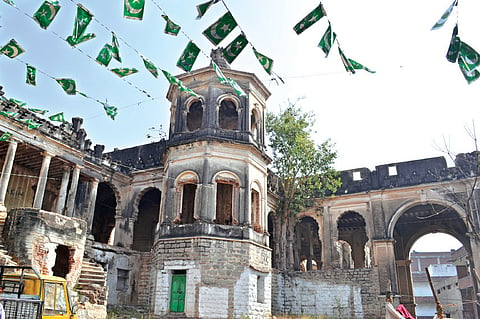

The city was a platform for major developments before and after the Nizam’s reign. Royalty, riches and grandeur were the status symbols of the Asaf Jahi dynasty. It was during their rule that Hyderabad gained immense popularity for the landmark changes they brought in – the first educational Urdu Unviersity, Osmania University, construction of Mir Alam tank (drinking water source), minting of their own currency, Nizam railways system, etc. The Nizam’s during their time also laid the foundations for many beautiful palaces. However, while we known of Chowmahalla Palace and Falaknuma palace, others have faded away into oblivion. Like the Mahbub mansion.
Located at Malakpet, the palace of the sixth Nizam is currently in complete ruin.
The building
Mahbub Mansion was constructed by Mahbub Ali Khan, the sixth of the Asaf Jahi dynsasty in the 19th century on the northern banks of the Musi river. Constructed in classical European and Mughal architectural style, the palace was a massive structure with a surrounding garden and a huge well. The main characteristics of classical European and Mughal artchitecture are canopies over windows, the intricate woodwork and the classical semi-circular arches. The roof of mubarak mansion is similar to the western block in King Kothi palace.
The palace had a ceremonial entrance which is similar to European mansions. At the entrance, there is a big semi circular arch flanked by two small arched alcoves. This arch had a pediment with intricate decorations which was further enhanced by crenellated walls and two small barbicans. The interiors of the living room had huge arches coloured in deep red with golden borders and beautiful cut glass chandeliers.
The once dark and light brown wooden flooring and marble statues added to its elegance. In its place now is a dull flooring that is barely recognisable. There was a huge iron gate which was brought from England, very similar to the one at Hyderabad Secratariat and on the River Thames (London), and was later installed at Chiraan fort. There are only eight gates which were designed to this look and size.
The palace was used as an occasional residence by the Nizam during horse races, his favourite sport. As the palace overlooked the race course, it gave the Nizam the luxury of watching his stallions right from his balcony where a small boulder like seat in the portico was his preferred viewing spot. It is believed that the palace was constructed for Sardar Begum, the Nizam’s beloved wife. Given that the purdah system was still widely practiced, the Nizam had mesh screens made from gold put up, so that the Begum could watch the horse races without being seen.
The overall architecture of the building is, in fact, similar to Nasir Bagh, the western block of King Kothi Palace.
The remenants
This extraordinary architectural structure is now in a debris. The palace that witnessed the greatest aristocracy has gone to ruin in recent times. This 110-year-old structure which has to be a landmark in history, is now a place for human waste, garbage and muck. The beautiful walls are totally worn out and the places where the golden arches stood is now just a ceiling with wooden beams. This building will also disappear into history as no care is being taken.
Prince Mukaram Jah had removed all the care takers from the palace due to mismanagement of his trustees and tax problems. According to historian Ghiassudin Akbar, the beautiful palace witnessed the bad times of vandalism and destruction.
“It was during the former chief minister, late Chenna Reddy’s time, that in and around the palace a grain market cropped up, leading to many encroachments. With commercial and residential complexes mushrooming in the area, the palace lost its charm and is in a sorry state,” he adds. “I have seen the Basheerbagh palace, Malwala palace etc being pulled down for commercial purposes and it immensely hurts to witness that sight,” says the 69-year-old.
The Hyderabad Metro Development Authority (HMDA) has in fact graded the palace as a historical monument, following which plans have been afoot for its restoration. However, nothing has materialised since due to lack of funds and the building has been further damaged.
