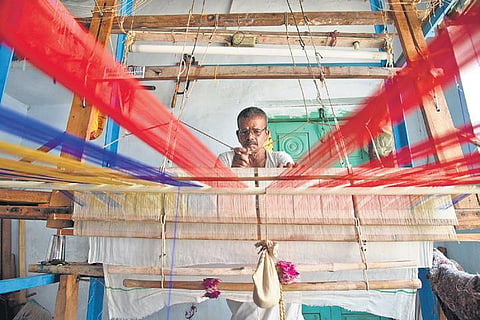

HYDERABAD: Weaved with tender loving care is what handloom is all about. Every garment has a story and the imperfections make them all the more personal, inspirable and real. We often neglect the fact that traditional hand-woven garments are planet-friendly, which is the need of the hour. While we read a lot and watch shows on the importance of switching to natural fabrics, apart from supporting weavers, how many of us have truly accepted hand-woven garments? How many of us are using sustainable garments on a daily basis?
We still save our handlooms for occasions with the fear of having to spend a bomb on dry-cleaning them after every use. On National Handloom Day, let us understand how switching to traditional weaves can make a difference to our environment. We also take a look at designers and prominent people in Hyderabad, who continue to push the envelope when it comes to promoting India’s timeless couture.

Doing their bit
Shilpa Reddy, a noted fashion designer and entrepreneur, has a lot to say on the subject. She has been promoting the handloom sector through social media and also shows her love for looms. “The designers in Hyderabad are contributing a lot towards handlooms. We have Gaurang Shah, who is the torchbearer not only for handlooms, but also innovative handlooms. He is mixing different kinds of weaves and creating something new constantly. Many other designers like Shravan Kumar and even I have switched from using synthetics to natural fibers,” she says.
For Shilpa, handloom is art, someone’s story, heritage, culture and the pride of our nation. “There is no other country on the planet, which could even come close to what we are doing or what we have been doing for centuries. The technique, the painstaking methods we use and implement — from dying and weaving to making the yarn — is no joke. It takes a lot of energy and skill,” she says.
Echoing similar views, Sudha Mullapudi, co-founder and CEO of Abhihaara Social Enterprise, feels that responsible production and consumption should be the theme for this year’s National Handloom Day. “Many people used to use handloom products until industrialisation came into the picture — handloom was replaced by synthetic fabrics. But today, there’s so much awareness. Even Minister KT Rama Rao has given a call to wear handlooms every Monday. Such initiatives have a significant impact. There are so many people, who have been living in Hyderabad for ages, but have not visited Pochampalli. But things are changing now,” she says.
Designer Archana from Archana and Puneeth has a different theory about the city accepting handloom. “Most people in Hyderabad have been using polyester, very few designers are using good ones though. But, down south, many are using a lot of natural fabrics. Switching completely to hand-woven clothes will probably take a few years. Only when stars and celebs come together for such causes, will the masses follow suit. Probably, when PV Sindhu wears a handloom piece, people will start wearing too,” she says. Archana is working on a kids collection which is based on the save wildlife concept. The garments are made of recycled and reinforced industrial yarn.
The Telangana government has also been doing its bit by encouraging yardage in traditional clusters. Every year, it holds fashion shows through which it encourages designers to showcase their handloom designs for across age groups.
Clean and sustainable
Wearing natural fabrics is not only good for the environment, but also for the body. If your wellbeing is your top priority, you must switch to handlooms, says Shilpa. “You don’t have to make major changes in your life, but if you switch to handlooms and if everyone’s wardrobe has only natural fabrics, we can save the art,” she says.
Future of looms
This sector certainly has a bright future — it has seen a major shift in its customer base. From being confined to saris and kurtas, today the fabrics are being used to design shirts and suits. “The idea is to make more and more people accept handloom as the modern day cloth. Twenty years ago, handloom was seen as janata cloth. Let us all wear handlooms not just to encourage the weavers, but also because these are beautiful, environment-friendly and comfortable,” says Shailaja Ramaiyer, Commissioner of Handloom and Textiles, Telangana government.
In fact, handlooms are making their mark in Indo-western fashion. Sudha credits the government and enterprises for this. “Today, youngsters are finding handlooms appealing.” Advising those aspiring to become fashion designers, Shilpa says they should push handlooms into the world market because India is the only country that can give the gift of handloom to the world.
Maintenance
Handlooms last, people have a misconception that they don’t and slight imperfections in the weave make the outfit more personal, inspirable and real, says designer Shilpa Reddy. Some fabrics need to be dry-cleaned, while some can be washed at home itself. Check out these tips to keep your natural fabrics in top shape
Double Ikkat silk and Telia Rumal: These have to be dry-cleaned. In case of Ikkat cotton, hand-wash the garment in cold water and use soap nut as your detergent
Kanjeevaram and Banarasi silks: Dry-clean only and always pack them in a Mul cloth bag
Patola: Dry clean only
Eri silk or Ahimsa silk: Dry clean only
Kalamkari: Maintain these fabrics just like Ikkat
Muga silk from Assam: Dry clean only
Tip: If your handloom has zari, preserve it in a cloth bag
— Tips by designer Archana from Archana Puneeth