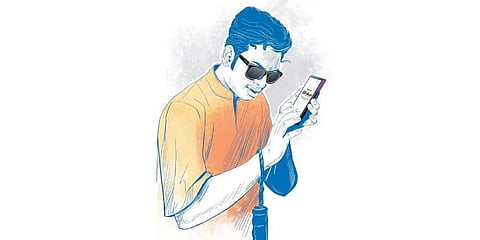

HYDERABAD: A new, QR code-based technology developed by a Hyderabad firm helps blind and partially-sighted persons label, scan and identify things around them. The smartphone application ‘Spacefelt’, designed by engineer Vivian Manohar, aims to help identify the right condiments from the kitchen cabinet to medicines, to read the numbers on a credit card and pick matching clothes without a sighted person’s help. Currently piloted at LV Prasad Eye Institute, the startup is a boon for working professionals and is no less for homebound with blindness.
While a few AI-based apps help identify everyday objects, they often give generic descriptions with unreliable accuracy. “The application works without an internet connection and has no boundaries. It is customisable, so the user can tag all the condiments they have difficulty finding.
One can scan and tag everything, and by scanning the QR code, they can find what they are looking for without the help of a sighted person at home or workplace, in any language they are comfortable with,” says Vivian Manohar, the CEO and founder of the company, Grailmaker Innovations which developed the app said.
The application, if purchased, comes with a set of waterproof adhesive tags and a mobile app to scan these tags. One can glue the QR to anything one wants to identify, scan the QR with the app, and record a text or audio description of the item one wants to remember. The recording is read aloud or played back the next time one scans the QR. “QR codes can be challenging for blind people because it takes a lot of dexterity to frame code correctly, but both QR codes and smartphones are evolved now, and our application is designed to capture it without difficulty,” Vivian added.
“The free version of the app (comes without adhesive QR stickers) will still allow users to scan common QR codes with the help of Assistive Technology,” Vivian, who also volunteered by reading books aloud for those with blindness at LV Prasad Eye Institute, said.The free version of the app can also assist the needy in museums, art galleries, restaurants, supermarkets and educational institutions.
There is a cloth tag as well. It can be used to find matching clothes, accessories, and footwear. Besides, Vivian adds, “At LV Prasad Eye Institute, all the doors are tagged with QR codes. It tells a person what the room is; its dimensions; it will tell them what other rooms this door opens into and how many steps it will take to get there.”
Some foreign apps do identify colours, but most are dependent on AI. Some people want definite descriptions at affordable prices. “We have a Sonic Labeller in the market, but it’s too expensive and AI-based. We offer 108 adhesive QR labels at `525, while our Assistive Technology application remains free. There are numerous future applications; for now, we are testing them in workplaces with inclusivity and educational institutions,” Vivian said.