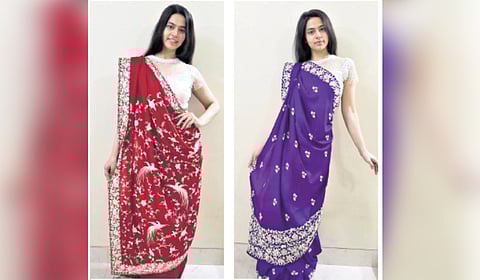

HYDERABAD: In traditional Indian attire, Gara sarees possess a rich history with intricate artistry, and timeless elegance. These sarees are cherished heirlooms that tell stories of cultural fusion, craftsmanship, and distinctiveness.
“The beauty of a Gara entirely depends on the unique designs, blend of colours and stitches used to embellish motifs with the Zardozi technique–that defines refinement in work,” said Zenobia Davar, a designer expert in Gara sarees.
She told CE that Gara work deploys the Zardozi technique where embroidery is meticulously crafted directly onto the fabric, using a small hand needle. This is different from the Aari technique, which is now being used in modern sarees. Aari uses a hook needle (or the cobbler needle) that pokes the fabric instead of going through it. The thread is then pulled up with the hook and is knotted before going on to the next stitch. “Aari technique is faster and tries to replicate what machines do,” said Davar.
“The earlier Garas were embroidered on beautiful hand-woven gajji silk, salli gaaj and pure jacquard materials. The Malabari yarn was procured from China, and there was a weaving centre in Surat where the fabric was woven. These fabrics were unique as despite being extremely thin and light, they could take intricate embroidery. Unfortunately, in the early 1970s, during the industrialisation of Surat, the setting up of mills and power looms, rendered the original artisans jobless. We have lost the art of making this amazing fabric forever. Even with all the technology available at our disposal today, it is not possible to make this fabric,” she implored, pointing out that even the most well-known institutions today do not work with the original technique.
The precursor to the Garas was the saree known as ‘Dorpat’, she told CE. “The Chinese fabric was 36-inch-wide whereas women in India wore 45-inch-wide sarees. So, a nine-inch-wide patti or fabric was woven and attached to the Chinese one to make it equal in width to the Indian fabric,” she said.
One of the most iconic motifs found in Gara sarees is the “Cheena Cheeni,” featuring a Chinese couple. Other motifs include the whimsical “kanda papeta” (onion and potato), polka dots, “marga margi” (rooster and hen), “chakla chakli” (sparrows), “karulia” (spider), and a plethora of birds and flowers. These motifs not only add aesthetic beauty but also carry symbolic meanings, like protection and purity—roosters heralding the dawn of new beginnings.
“The history of Gara sarees traces back to the Parsi merchants who traded with China. These traders brought back exquisitely embroidered fabrics from their journeys. The fabric was initially sold as yardage or by-the-yard, before being transformed into the iconic six-yard saree,” said Parvez Chenoy from Hyderabad.
Despite challenges of wartime disruptions and cultural shifts that drew a slumber in Gara fashion, these sarees endured, becoming treasured possessions passed down through generations.
Parvez Chenoy says that some of their Garas are 100 years old. “Most women usually wear their traditional Garas on special occasions, like weddings. It is considered lovely for a new bride to have at least one Gara as part of her trousseau. However, one of the distinctive features of Gara sarees is the meticulous care they require. Maintaining a Gara saree is a labour of love and dedication. However, modern iterations of Gara sarees utilise different fabrics like crepes and chiffons, making them more accessible for everyday wear while retaining their exquisite beauty,” she said. The allure of Gara sarees extends beyond their aesthetic appeal; symbolising heritage, elegance, and a connection to the Parsi identity.