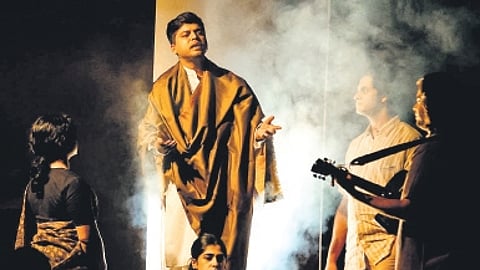

HYDERABAD: The idea of telling the story of Sahir Ludhianvi’s life first took birth in the mind of the creative director Amita Talwar from Art for Causes, who wanted to make documentaries on some legendary poets. These projects culminated on stage, which she said, “has been far more exciting.” She approached Mir Ali Husain, writer of the film Mee Raqsam for this play, and later Himanshu Bajpai, the well-known Dastango and scholar also got involved. Sahir is played by Danish who also directed the play.
Excerpts from CE’s interview with him:
How did you come to play this role?
I was familiar with Sahir Ludhianvi as a poet and beyond. In 2017, I was invited to a Jashn-e-Rekhta programme where I was to speak about the lives of the poets involved in the Progressive Writers Movement. I researched Sahir and got some tidbits about his life during that process. I also read Mir Ali Husain’s book which had a chapter on Sahir Ludhianvi and Rakhshanda Jalil’s work on the same. In some sense, I’d read his poetry, but I had not taken a deep dive into his work. Then Amita Talwar called me and said she had a script and would like to collaborate with me. When I heard Mir Ali Husain’s name, I agreed immediately. I had also worked on a film that he had written, Mee Raqsam, directed by Baba Azmi. I got excited because I know the calibre that he brings as a scholar and writer.
How did you respond to the script?
When I read his script, I had no idea that I would get so sucked into Sahir’s life and philosophy. The man always punched above his station, spoke truth to power, and had a very soft heart for people who were weak or marginalised and voiceless. It’s just a remarkable story that I felt had to be told.
How does one enact a legend on stage?
It is more challenging to portray those historical figures who are well-documented because there are facts available in the form of their interviews, and documentaries. Many people have seen them alive. In Sahir’s case, there were just pictures and audio of him, but not many great videos. Most of his contemporaries are now gone. So I realised the idea is not so much of Sahir—the person that needs to be brought alive on stage but more of Sahir—the idea, the philosophy, the poet, the warrior and the spokesperson of the marginalised. That is more important than just maintaining the semblance of his physical reality. I think that thing worked. Irrespective of whether I’m copying Sahir’s manners or not, the character Sahir comes alive for people on stage. And I think that’s really what the purpose is.
Is there also a reference to his association with Amrita Pritam in the play?
Yeah, there is. But what one needs to understand, Amrita Pritam was just one aspect of his life. His life did not centre around her but his poetry and his mother. I think, because Amrita has written extensively about him, sometimes people forget from what point of view they are looking at Sahir’s life. If you were looking from Amrita’s point of view, possibly more of Sahir would appear in the story. But from Sahir’s and his contemporaries’ point of view, he is much more than somebody romantically involved with Amrita Pritam.

And very interestingly, the title of the play is also, ‘Main Pal Do Pal Ka Shayar Hoon’…
The script by Mir Ali Hussain was called ‘Aao Ki Koi Khwab Bune’, which is also taken from one of Sahir’s famous poems. The script that Himanshu Bajpai wrote was called ‘Dastaan-i-Sahir’. I gave the play this title because it has the maximum recall; everybody knows Sahir has written it. And also, in some sense, encapsulates what the man was. Here, I feel, Sahir is talking about himself. It represents him the best.
What are your expectations from the Hyderabad audience?
All the four shows in Mumbai and Delhi have been sold out before the performance. In Hyderabad, it is for a noble cause as Art for Causes is an organisation that works for the health and education of the underprivileged. It would really be a noble cause for Hyderabadis to buy donor passes to help the children in their city who are worst hit.
As a performer what has been your takeaway from this project?
My takeaway from this project is the spine to stand up and speak truth to power, which Sahir Ludhianvi did. That is something that touched me and I think that’s the core of the play: not to succumb to what is happening around you. It urges you to pause, reflect, observe, and then make your statement and to hold your own.