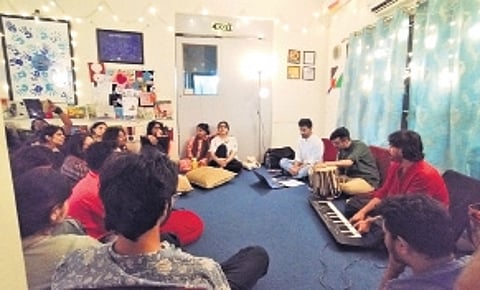

HYDERABAD: The event ‘Begumpura in Begumpet’ was one of the unique happenings in the city. The reason is threefold: taking pleasure in community-centred joy, breaking the shackles of caste and hierarchy and fostering the growth of ideals as one would see in a utopia.
On the occasion of Ravidas Jayanti, Pause for Perspective — a city-based mental health organisation with a social outlook — invited the Delhi-based duo Ruhan and Minnatullah Khan to perform dohas of saint Ravidas, Kabir and sing ghazals and songs from the Sufi tradition.
Begumpura is an inspiring anti-caste utopia envisioned by Guru Ravidas and is depicted as an ideal city free from suffering, discrimination, and social hierarchies, in his hymn ‘Begumpur Seher Ki’. It serves as a metaphor for Guru Ravidas’s unwavering commitment to equality, justice, and the pursuit of a utopian society.
“Saint Raidas and Kabir wanted to break the institutions of oppression and wanted a place where everyone was equal. We, as The Khayaal Project, have tried to spread the message of equality and peace. Not only that, we highlight classical music to go beyond the concept of belonging to a ‘gharana’ that acts as a gatekeeper for people from diverse backgrounds. We sing everything ranging from Sufi music (hamd, naat, manqabat and qaul), Khayaal Gayaki, shabadhs, geet, bhajans and ghazals,” Ruhan said.
Meherin, from Pause for Perspective, told CE how the idea of a utopia presented by Saint Ravidas inspired them to host this event to bring together people in a shared activity of healing and transformation. “This came out of an intention to see how anti-caste work in the mental health space and a social justice context would look like when we bring in community-centred rest and joy because those are components that we barely speak about when we think of inclusion. We often forget that oppression and constant erasure leave bodies in a state of freeze-and-flight response, with no space to process the trauma. What we all want, essentially, a utopia, a free and warm space,” she said.
The event, divided into two parts, had the performance by The Khayaal Project and other artistes, followed by a session of reflection, where the audience members shared their ideas of utopia and why it is often perceived as a realm of impossible dreams. For Meherin, coming together in a common space to share joy and pleasure is a form of resistance that aims to create a space free from oppression and violence. “It was three to four hours of limitless joy and transcendence. And a textbook case of what resistance can look like when we revel in shared joy and access pleasure in music and art,” she said.