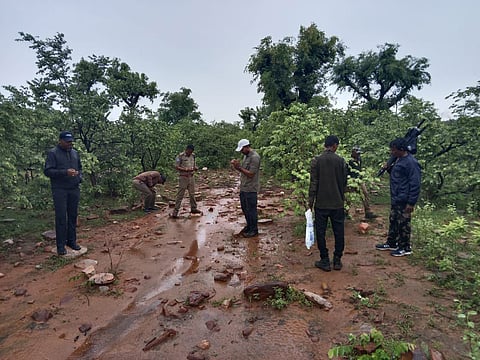

HYDERABAD: For the forest personnel of the Amrabad Tiger Reserve, patrolling is an everyday duty but during the monsoon, it turns into a high-stakes mission. Swollen nalas rise to chest-deep crossings, inspection paths are washed away, and familiar routes become obstacle courses. Yet, officers say this is when vigilance is most critical.
Rohith Gopidi, divisional forest officer of Amrabad Tiger Reserve, explains: “The rains bring an explosion of life. Wildlife activity peaks, with many species entering their breeding cycles. Tigers, in particular, begin to move across territories after rains wash away their scent marks. The big cats then re-mark their boundaries, triggering increased movement and encounters. Other animals, such as monitor lizards, emerge from burrows after showers, a behaviour that often draws poachers using trained hunting dogs.”
With roads often cut off by heavy rains, foot patrols become more important than vehicle patrols. The reserve’s 2,611 sq km area is divided into 256 beats.
Of the 340 uniformed staff, only about 170 are currently active on the ground, assisted by another 170 animal trackers known as watchers. Over a month, the data from all staff is analysed to identify “grey areas” where patrolling is weak, and routes are adjusted to ensure coverage.
However, communication barriers remain the biggest challenge. Gopidi says, “Dense, shoulder-high grass often conceals animal movement, increasing the risk of sudden encounters. In some beats, poor wireless coverage hampers emergency communication, and heavy rains can completely isolate staff from assistance.
With weather conditions changing rapidly, the lack of reliable connectivity can make sending distress calls nearly impossible.”
To reduce travel time, 30 to 40% of staff stay in deep-forest base camps for several days, equipped with solar power, basic facilities and kitchen gardens.
While on patrol, teams deploy camera traps at set intervals, checking footage weekly to monitor tiger movements and breeding stages.
Drones are used less for patrolling and more for fire management or assessing injured/problematic animals from a safe distance.
Detailed behavioural tracking informs management strategies such as taking extra caution around tigresses with cubs or ensuring urgent compensation payouts to villagers when tigers kill cattle, to avoid retaliatory killings.
“The monsoon is a time when people stay indoors,” the officer sums up. “But for us, it’s the busiest season of the year. We can’t afford to stop moving.”
