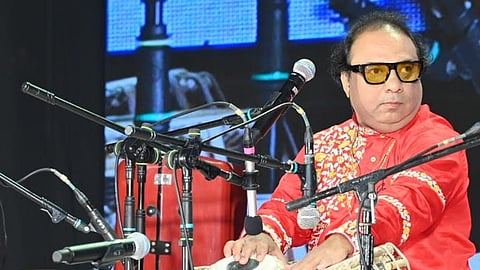

Most of us grew up with Harry Potter on our bookshelves and screens, didn’t we? Whether it was Harry’s ability to conjure a powerful charm, Hermione’s mastery of advanced spells, or Ron’s strategic brilliance at wizard chess, we were left in awe as we witnessed their sheer magic. Well, we were lucky to witness some real magic on stage when percussion wizard Pandit Prodyut Mukherjee alighted in the City of Pearls to perform at One World Fusion 2025 in Ravindra Bharathi. Pt Prodyut, who is also a Grammy jury member and Global Indian Music Academy Awards (GiMA) winner, chats with CE about his musical journey, band, and more.
Like most great musicians, Pt Prodyut entered the realm of music when he had barely learned to spell. “I was just five when I started learning Hindustani Classical Music. At 16, I began performing publicly. My gurus were Pandit Manik Pal and Pandit Shankar Ghosh from the Farrukhabad Gharana, and Padma Shri Pandit Swapan Chaudhuri from the Lucknow Gharana,” he says.
But in 2014, after years of performing, a harsh reality gripped Pt Prodyut’s mind: audiences and sponsors were dwindling for regular Hindustani Classical Music performances. How to make this interesting? His answer was to create a band called ‘Rhythm Express’, a fusion band which seamlessly blends Indo-Occidental melodies and Afro-Latin influences, with Pt Prodyut powering it with percussion and soundscape. It was this vision that won him a GiMA award in 2016, for ‘Moods’, a track from the Rhythm Express album, a collaboration between him and Pandit Vishwa Mohan Bhatt.
“Essentially, I draw from the styles in the Farrukhabad and Lucknow gharanas and add my own style too. I also borrow the Varanasi gharana’s baya technique; the melodic bass creates a mesmerising auditory experience reminiscent of thunderstorms and the rhythmic cadence of trains,” he explains.
Pt Prodyut reveals that his unique musical style, which involves, among other effects, chugging train sounds, the pitter-patter of raindrops, and conch sounds, has captivated both five-year-olds and 100-year-olds alike. But what does this maestro’s creative process entail? “When I get time while travelling and touring, I just hum some raags, like Kirwani, Madhuvanti, Charukesi, etc, and record them. Later, I go to the studio and develop them into full compositions,” he says. His love for music cascaded into Mother Earth when he launched a tree plantation initiative at Santiniketan and named the trees after raags. A gulancha tree, named Desh, stands in remembrance of Operation Sindoor, while an amaltas tree named Lalit honours the rich cultural heritage of Santiniketan.
A Grammy jury member today, Pt Prodyut has the cherished and much-envied task of picking victors among an array of voices. “I serve as a cultural ambassador, and this allows me to promote Indian music on the global stage,” he expresses.
But he laments that there exists a pressing issue today: “Youngsters today, though bursting with talent, are taking the wrong route by learning how to sing from YouTube and reels. What they really need is a guru.” Although he subscribes to the guru-shishya parampara tradition, he opines that gurus need to be friendly, guiding students with both discipline and kindness. He recounts a culinary memory with one of his gurus, Pt Swapan: “I was in San Francisco for a concert, and my guru, an excellent cook, decided one evening that he’d make some Western-style chicken. I became his sous chef, chopping chillies and onions — though the latter made me cry, the tears vanished as soon as I tasted the delicious chicken!”
Pt Prodyut wants to help the next generation by opening a gurukul and imparting knowledge free of cost — a truly magical initiative. He shares, “I want to teach students not just how to sing, but how to perform, navigate the music world, and interact with journalists — not to mention handling a sound check, which is so important!”
