
There is something almost meditative about watching a wall rise not from bricks, dust, and noise, but from smooth, layered contours of engineered material — printed, not built. As conversations around the future of construction sweep across the world, India too is entering the quiet revolution of 3D-printed architecture.
In Hyderabad, we spent time exploring this emerging frontier, Ridhira Group’s world’s first 3D-printed resort living community at Ridhira Zen — shaped by technology, wellness philosophy, and a desire to rethink what homes of the future might feel like.
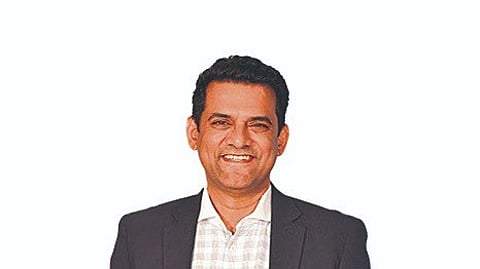
As we continued to explore, Ritesh Mastipuram, founder and managing director of Ridhira Group, explained how the idea behind this transition took shape. “Basically we are building how communities of the future will look, feel and act like. Because we are at an inflection point as a nation. The idea was how do we leverage that, build a framework and a sort of an experiential layer so that we are able to cut down the number of variables that come to force from a design stage to action delivery,” he said.
Even without understanding the engineering behind the machine, the reduction of those ‘variables’ is visible. Much of what differentiates 3D-printing becomes apparent only when you stand beside the freshly printed walls. The absence of rubble is the first clue. The second is the structure of the wall itself — layered, hollow, insulated.
“With 3D-printing, the on-site wastage is reduced by more than 78 percent,” Ritesh said, pointing to a near-clean work area around a printed frame. The deep cavities between the printed layers caught our attention next. They aren’t flaws; they serve as natural thermal buffers.

He explained, “In 3D-printing, we are able to sort of have a cavity of more than 8 to 10 inches, we are able to do a lot more high quality thermal shading… energy consumption comes down significantly.”
Hyderabad’s weather adds another layer to the experiment. “We are blessed to be in Hyderabad, where 10 months in a year, you’re able to open your windows and experience a very calm, comfortable, outdoor–indoor life,” he shared.
The choice of form: sweeping curves, softened edges, uninterrupted shapes — comes from the technology’s ability to bend without resistance. It also allows layouts that merge functionality and energy flow. “What 3D is able to help us do is sort of curate spaces which are 100 percent vastu compliant but still be quite experimental in our architectural choices,” he said.
As we walked through the site, one of the themes that kept returning was perception — the hesitation people have toward unfamiliar methods. Ritesh put it simply: “The most surprising thing, quite honestly, is that it’s really unbelievable to understand how paranoid people are. We felt that it is really stupid not to embrace such technology. And instead of doing it with other people’s money, if you do it with your own money, you’re able to showcase that as an example for the world.”
Beyond the structure itself, the way spaces connect also plays a role. Corridors and pathways are being imagined as sensory conduits rather than mere routes. “We have taken the eight dimensions of wellness as the primary driving force… pathways as opportunities to curate experiences around sound… creating an environment where there is a lot more interaction, a lot more community feeling,” he summed up.