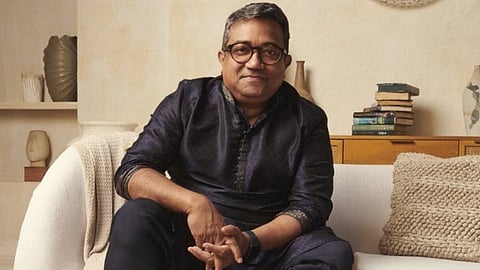

When Prabhas signs on to headline a film, the canvas widens — and for Fauzi, it is Sudeep Chatterjee who steps in to command that scale. As he prepares for his Telugu debut with the Prabhas-led action drama, the cinematographer brings his own battalion to the frontlines: unflinching honesty, restless curiosity, and a discipline sharpened since the days he first picked up a still camera.One of Indian cinema’s most accomplished visual storytellers, Sudeep disarms you with a humility that feels almost at odds with the sweep of his work. From Chak De! India and Bajirao Mastani to Padmaavat, Gangubai Kathiawadi, Housefull 4 and Chotushkone, he has defined the emotional pulse of frames that millions carry with them — without ever carrying the weight of that legacy himself.
At the 11th edition of the Indian Photo Festival, Sudeep found himself in familiar company. “I was honoured to be among like-minded people,” he said, adding, “We are people who see the world and express it visually. There’s a natural camaraderie there. More than anything else, I was excited to meet people who speak the same visual language.”
Photography is where his journey began. Long before the elaborate lighting rigs or the operatic visuals of Bajirao Mastani, there was simply a boy trying to express himself visually, without the tools of painting. “I always felt the desire to express myself visually,” he recalled in a conversation with CE, adding, “But I wasn’t trained in painting. I tried many times and would get frustrated because I didn’t know the technique. Photography changed that for me. When I started using a camera, I realised I could create the image I had in my mind.”
Cinematography followed naturally, an evolution rather than a shift. “With my interest in photography and cinema, cinematography was a very natural choice,” he said. Yet he sees the two mediums as intersecting only in intention. “In cinematography, the image has a temporal quality. You can’t look at it for as long as you want. The image becomes just one instrument in a large symphony — editing, sound, dialogue, music — all coming together to tell a story,” he added.
Photography, however, offers freedom. “When I do street photography, I create my own stories. I can look at a photograph for as long as I want. It helps me tremendously. When I look at anything, I instantly see the frame, the lens, the angle. That habit has come from still photography.”
For Sudeep, cinematic style begins with the script. His visual world is not determined by the opulence of Bajirao Mastani or the grounded grit of Chak De! India, but by the emotional truth contained within each scene. His process, he explained, is rooted in holding onto the feeling the script first evoked. “I keep returning to that thought — what did I feel when I read this scene? Am I communicating that emotion through these shots?” he shared.
Collaboration has shaped him immensely, especially with directors like Sanjay Leela Bhansali and Nagesh Kukunoor. Despite two National Awards — one for Chotushkone and another for Bajirao Mastani — Sudeep remains reflective rather than celebratory.
His pride surfaces most when he speaks of the Indian Society of Cinematographers. “It’s my proudest association,” he said, adding, “It’s a beautiful community of people to whom the image really matters. We have mentorship programmes and initiatives for cinematographers.”
