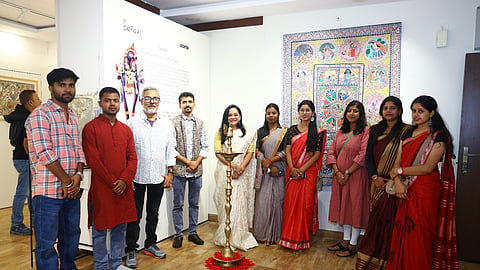

Steeped in spiritual symbolism and Mithila’s storytelling legacy, EkChitra’s Daivatvam — Divinity stands out as one of Hyderabad’s most compelling exhibitions this year. Presented by Annapurna Madipadiga and curated by Avinash Karn, the showcase, open till December 10 at EkChitra Art Gallery, brings together an intergenerational spectrum of Mithila works, from traditional practitioners to contemporary voices, including rare pieces by late masters seldom seen today.
Explaining the vision, curator Avinash Karn says, “All the artists share the same aastha, but their way of portraying it is different and that is what we wanted to convey.” Reflecting on assembling his first curatorial project, he credits Mithila art conservationist Kaushik Kumar Jha for guiding him. “While discovering these artists, it felt as though the gods themselves were supporting the concept,” he adds.

‘I remain faithful to the Madhubani parampara’
The artwork I’ve showcased in this exhibition is based on Daivatam. I created Vishnu ji’s virat roop (cosmic form), focusing on the intricate lines and dots of Madhubani art. The background features baariq water-pattern detailing. I primarily work with lines, and here I elaborated the virat roop described in the Bhagavad Gita, a moment from the yudh bhoomi. The work reflects the Mahabharata war scene, with horses, the rath and weapons. In Madhubani art, we first draw the lines, then outline the concept, and only then complete each figure, ensuring the background aligns with the theme. For this piece, we filled the background first and then added our fine patterns. I stay faithful to Madhubani parampara, adding only a touch of my own uniqueness, especially in showing Arjun bowing to Krishna.
— Shalini Karn, generational Madhubani artist
‘Devotion isn’t limited to pooja’
For Daivatam, I created a painting of Durga Maa. As a devoted follower, I wanted to express my own thoughts rather than repeat what is commonly shown. Devotion isn’t limited to performing pooja; there are many ways to make the goddess happy. The piece is made on handmade sheet using acrylic colours, entirely in the Kachchni style. Inspired by Durga Maa’s nine roop, I tried to show how they can guide the current generation. The first form, Himalaya ki Beti, reflects how when a girl is born and someone donates in her name, kisi gareeb ka bhala hota hai. The work captures this spirit of devotion. Though Madhubani art traditionally uses bright colours, I followed what came to me intuitively — Durga Maa’s presence expressed through the lifecycle of a woman; while ensuring the essence of the art form remained intact.
— Akansha Kumari, student
‘Sita’s love guided my work’
Any artist hopes to see their work displayed meaningfully, and EkChitra felt right for me. Avinash ji told me about the exhibition while planning it and shared his vision of bringing the Daivatvam (divine essence) of Mithila to audiences. Mithila is Prem ki Bhoomi (land of love) and Sita ki Janmbhoomi. Marriage is celebrated with great grandeur, and Sita’s love came to my mind, how she first encountered Lord Ram. My painting is based on the Ramcharitmanas, depicting the khand (chapter) where Sita Maa meets Ram. The entire scene is set in the Phulwari, where they first saw each other. Choosing this setting is challenging — it demands freshness, emotion, and colours that convey love. Keeping this in mind, I created this painting.
— Pratik Prabhakar, creative Madhubani artist and instructor