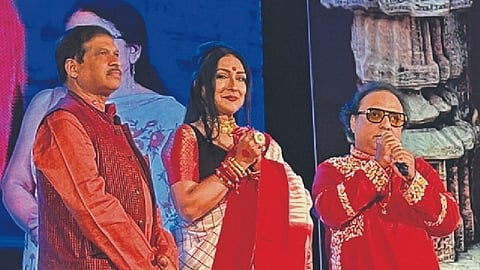

When the breezy December weekend came to the city of Hyderabad, it slowed down its busy and fast pace, becoming calm and methodical through raga, movement, and anticipation of Ustad Bade Ghulam Ali Khan National Festival of Music & Dance. Held at the Ravindra Bharathi, the auditorium became the music and dance festival space for the weekend; two nights filled with richness, informal discussion, and preservation with the festival’s 8th edition.
Echoing the sentiments of the festival, Abhijeeth Bhattacharjee, chairman of the Sangitanjaly Foundation, highlighted the festival’s diversity, noting, “It is not limited to one genre — it brings together vocal music, tabla, santoor, shehnai, and dance, creating a space where different classical traditions and audiences come together.”
The first presentation of the festival took place on December 13 with Odissi dancer Jagriti Chakraborty performing the opening with the Odissi performance. The presentation began with the Mangala Charan, progressed through the different forms of Odissi dance with the compositions, Janapada bhajans, and semi-classical forms, and completed with the tribute piece in recognition of the 150th Anniversary Celebration of Vande Mataram.
Following the inauguration, a jugalbandi by Pt Lokesh Anand on shehnai and Dr Bipul Kumar Ray on santoor, accompanied by Pt Durjay Bhaumik on tabla, unfolded with expansive, breath-driven phrasing and shimmering resonance. The instruments conversed naturally, moving between meditative alap and measured rhythmic play. The evening concluded with a vocal recital by Vidushi Ivy Banerjee, whose tonal restraint and emotional nuance were supported by Ratan Bhattacharjee on harmonium and Samir Acharya on tabla, bringing the night to a composed and resonant close.
December 14 continued the festival’s journey with sitarist Pt Partha Bose and Pt Durjay Bhaumik on tabla. Then came sarod player Sanjay Chakraborty and tabla player Samir Acharya, whose clarity and depth drew the audience into the ragas’ inner architecture. The vocal centrepiece was a jugalbandi by Ritesh and Rajnish Mishra, whose synchronised singing reflected years of shared sadhana, enhanced by Ratan Bhattacharjee and Pt Durjay Bhaumik.
The finale featured a classical dance presentation by Rituparna Sengupta, whose expressive performance integrated movement, narrative, and musical sensitivity. She also performed a fusion Ravindra piece, accompanied by music composed by Pt Prodyut Mukherjee. Rituparna reflected, “It was an honour to be part of this festival in Hyderabad. I was unusually nervous — I have rarely felt this nervous in front of cameras — but being on stage in reverence to Ustad Bade Ghulam Ali Khan made the experience deeply moving for me.”
Meanwhile, Pt Prodyut Mukherjee, Grammy Jury member and Governor’s National Excellence Awardee, explained that the festival doubled as a fundraising initiative for children with autism. He shared, “This Festival is in aid of children at the Autism Ashram. Our aim is to take Indian classical music forward. We are planning to open a music academy in Hyderabad where children will be taught free of cost.”
The festival concluded with a celebratory note as Rituparna Sengupta was honoured with the Sangitanjalay Excellence Award, recognising her outstanding contribution to classical dance and her deeply moving performance.
