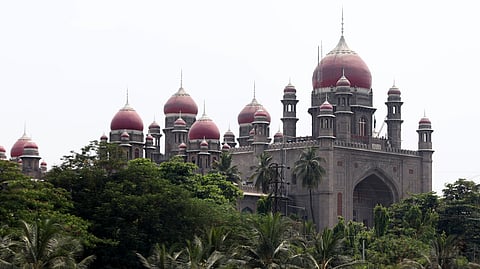

HYDERABAD: Questioning the legal basis of traffic challans, the Telangana High Court has directed the government to file a detailed counter-affidavit in two writ petitions challenging current traffic enforcement practices.
Justice NV Shravan Kumar asked the Government Pleader for Home to submit the affidavit within a week and posted the cases for hearing on Dec 23.
In the first petition, the petitioner argued that Telangana has not adopted the 2019 amendments to the Motor Vehicles Act, 1988, and that challans are being issued under the original Act and rules. It was contended that Section 128, dealing with rider safety, does not prescribe a specific penalty and must be read with Section 177, which provides for a fine of up to Rs 100 for a first offence and Rs 300 for subsequent offences.
The Government Pleader said the issue had been rectified and produced a revised integrated e-challan citing Sections 127, 128 and 184 of the Act. However, the court noted discrepancies, observing that the challan mentioned only the vehicle owner’s name, lacked clarity on the provisions invoked and did not reflect the petitioner’s name.
In the second petition, the practice of stopping motorists to collect pending challans was challenged, with the petitioner arguing that offences involving imprisonment cannot be compounded by police and must be decided by a judicial magistrate.
Relying on GOMs No.108, the Government Pleader said compounding was permitted and added that no discounts on pending challans had been offered after 2023. He also said charge sheets had been filed against violators who failed to pay fines.
Petitioner’s counsel cited Section 208 of the Act and Rule 164(d) of the Central Motor Vehicle Rules, 1989, to argue that offences under Section 184 relating to dangerous driving cannot be compounded. The court was also told that while police produced an image allegedly showing triple riding, they failed to explain the equipment used to capture it.
